
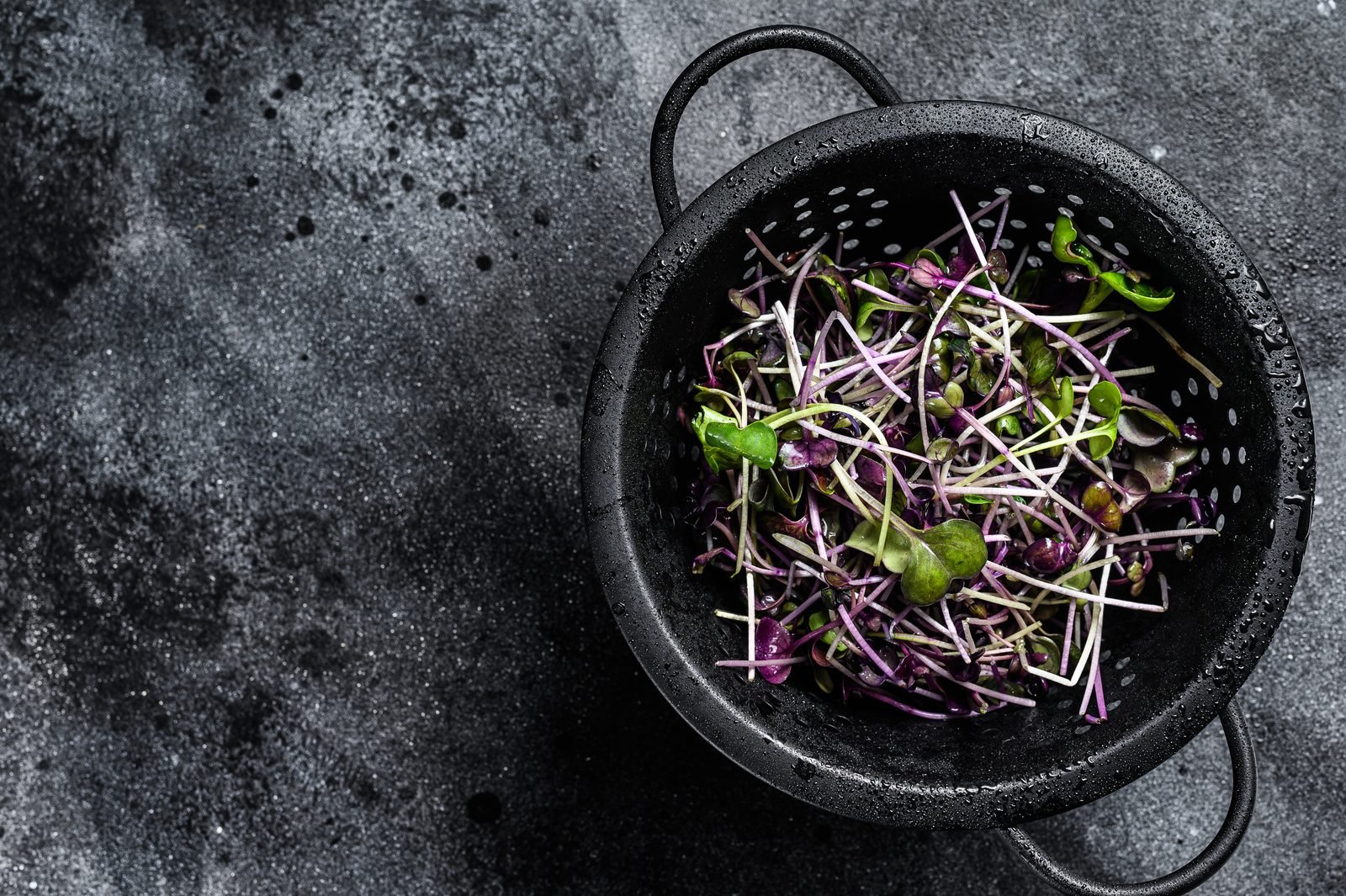
Microgreens need a gentle wash.
They grow close to the soil or growing mat, and they reach your plate raw. A quick rinse right before you eat them is a simple safety step. Wash them too early, though, and they can turn limp in the fridge. Wash them too hard and the thin leaves bruise. This guide shows how to wash microgreens the right way, step by step. It covers when to rinse, how to dry them, what to leave out of the sink and how to handle greens cut from a living tray. Each step has a source behind it.
Key Takeaway
Wash microgreens right before you eat them, not before you put them in the fridge (New Mexico State University, n.d.). Rinse them gently under cold running water in a colander, then pat or spin them dry. Skip soap, vinegar and produce wash. Plain water does the job.
Below: the method, the timing, drying, what to skip at the sink, living trays and pre-washed packs.
Microgreens 411
Find a microgreens grower near you
Greens that travel less start fresher in your fridge. Find my local grower →
Table of Contents
- How do you wash microgreens?
- When should you wash microgreens?
- How do you dry microgreens after washing?
- Should you use soap, vinegar or produce wash?
- How do you wash microgreens from a living tray?
- Do pre-washed or farm-fresh microgreens need washing?
- Wrap-up: how to wash microgreens, in short
- Frequently asked questions
- References
How do you wash microgreens?
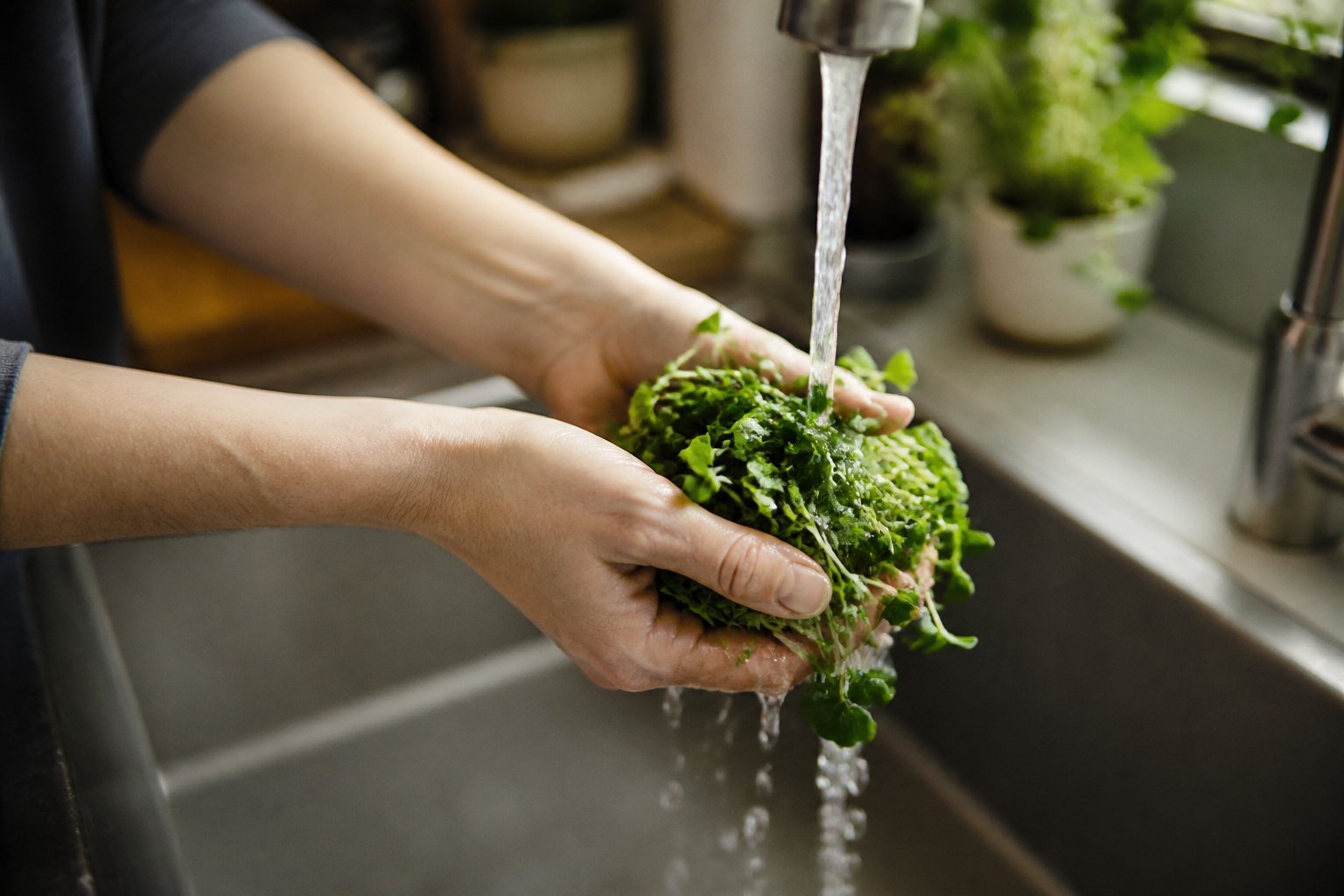
Rinse them gently under running water, just before you use them. That is the core of how to wash microgreens. The FDA advises washing all produce under running water before you prepare or eat it. That goes for produce from a store, a farmers market or your own garden (U.S. Food and Drug Administration, 2024).
Microgreens need a lighter touch than most produce. New Mexico State University calls them very delicate and warns that even washing can be rough enough to damage them (New Mexico State University, n.d.). So treat them like soft herbs, not like potatoes.
Here is a simple method. Take out only the amount you plan to eat. Put it in a colander or mesh strainer and hold it under a soft stream of cold tap water. Turn the greens with your fingertips so water reaches the stems and leaves, and pick out any seed hulls or bits of growing mix.
Does a rinse help? In one lab study, washing mung bean, lentil and mustard microgreens in distilled water for two minutes lowered their overall microbe count somewhat (Priti et al., 2022). This advice is for microgreens. Sprouts are grown differently and carry separate warnings, and our sprouts guide explains the difference.
| Step | What to do |
|---|---|
| Timing | Right before you eat them |
| Water | A soft stream of cold running water |
| Drying | Clean towel, paper towel or a gentle spin |
| Skip | Soap, detergent and commercial produce wash |
When should you wash microgreens?
Wash them when you make your meal, not when you get home from the store. New Mexico State University puts it plainly: wash microgreens when preparing your meal, not anytime before (New Mexico State University, n.d.).
Early washing causes two problems. It damages the fragile tissue, and it adds moisture. Over time, that moisture can raise bacteria growth and shorten shelf life (New Mexico State University, n.d.). The same source says microgreens should be kept dry, since a damp setting suits the bacteria that cause foodborne illness.
Penn State gives the same advice to home growers. Its guide notes that the plant tissue is very gentle and that shelf life may drop a lot after washing (Di Gioia, 2026).
Timing is half of how to wash microgreens well, and the habit is easy. Store them dry and unwashed in their container. When you are ready to eat, take out one portion and wash only that. The rest stays dry for another day. Our storage guide explains how to keep the unwashed greens fresh in the fridge.
How do you dry microgreens after washing?
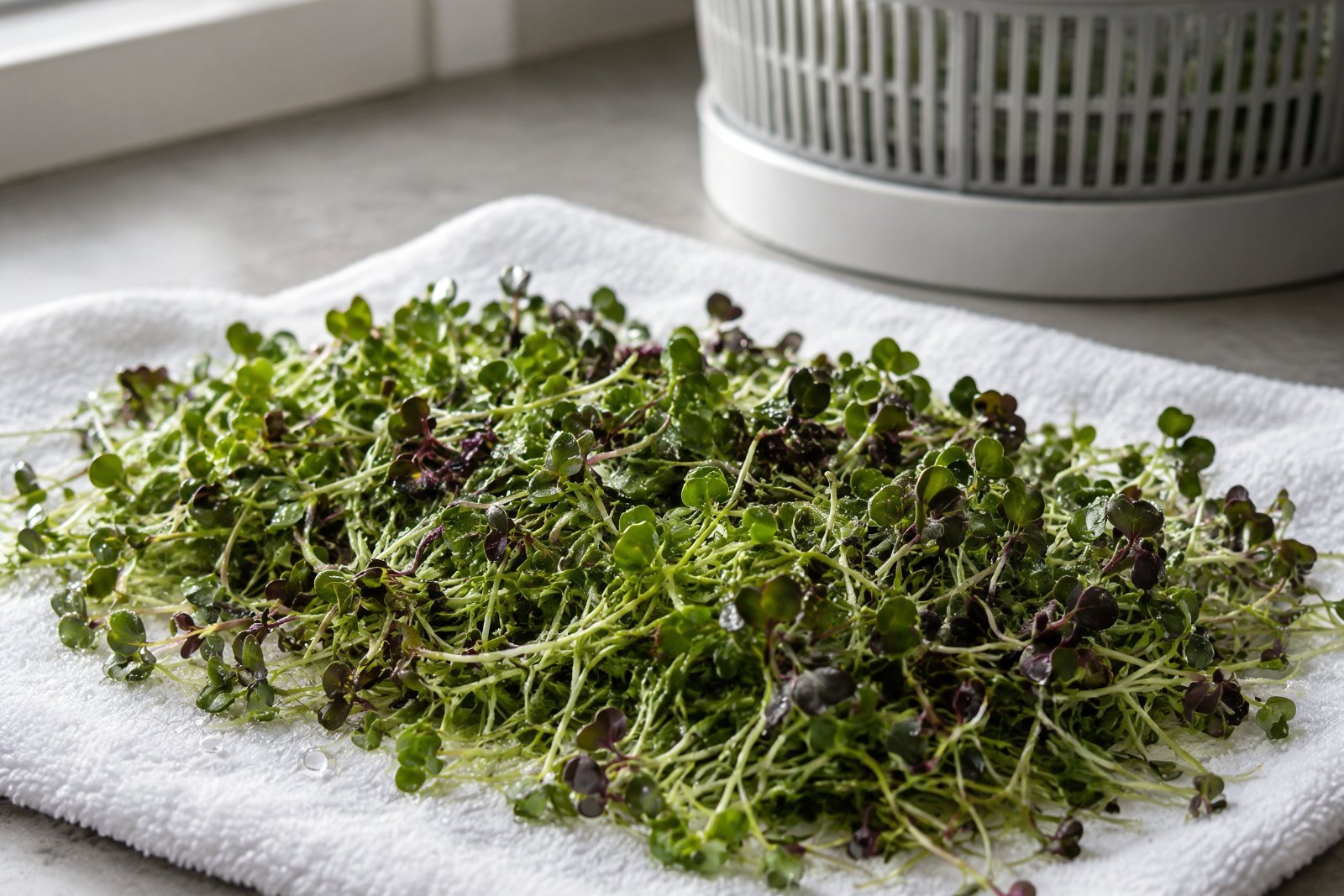
Pat them dry with a clean towel or paper towel right away. The FDA says drying produce with a clean cloth or paper towel after washing can further reduce bacteria on the surface (U.S. Food and Drug Administration, 2024).
With microgreens, a soft touch works best. Spread the rinsed greens in a single layer on the towel. Lay a second towel on top and press lightly. Don’t rub them, since the leaves bruise easily.
A salad spinner is another option for a bigger batch. Use short, gentle spins and don’t pack the basket full. New Mexico State University says rough handling can harm these plants and give them more chances to go bad (New Mexico State University, n.d.).
Leftovers are the main reason to dry well. If you washed more than you can eat, any water left on the leaves will cut their fridge life short. Dry them fully and eat them soon. Our shelf life guide covers how long they keep.
Drying is the step most people skip when they learn how to wash microgreens. It takes about a minute.
Should you use soap, vinegar or produce wash?
No. Plain running water is the method the FDA recommends. It says washing fruits and vegetables with soap, detergent or commercial produce wash is not recommended (U.S. Food and Drug Administration, 2024).
The FDA gives two reasons. Produce is porous, so soap and household detergents can soak in, even after a good rinse, and can make you sick. And the safety of residues from commercial produce washes is not known, and their effectiveness has not been tested (U.S. Food and Drug Administration, 2024).
What about vinegar or lemon juice? A Tennessee State University study tested home washing methods on lettuce, broccoli, apples and tomatoes. Lettuce soaked in a vinegar or lemon solution showed no significant difference in bacteria drop from lettuce soaked in cold tap water (Kilonzo-Nthenge et al., 2006).
That study used lettuce, not microgreens, so it is not the final word. Still, it gives no reason to reach for the vinegar bottle. For how to wash microgreens at home, cold water and gentle hands are enough.
How do you wash microgreens from a living tray?
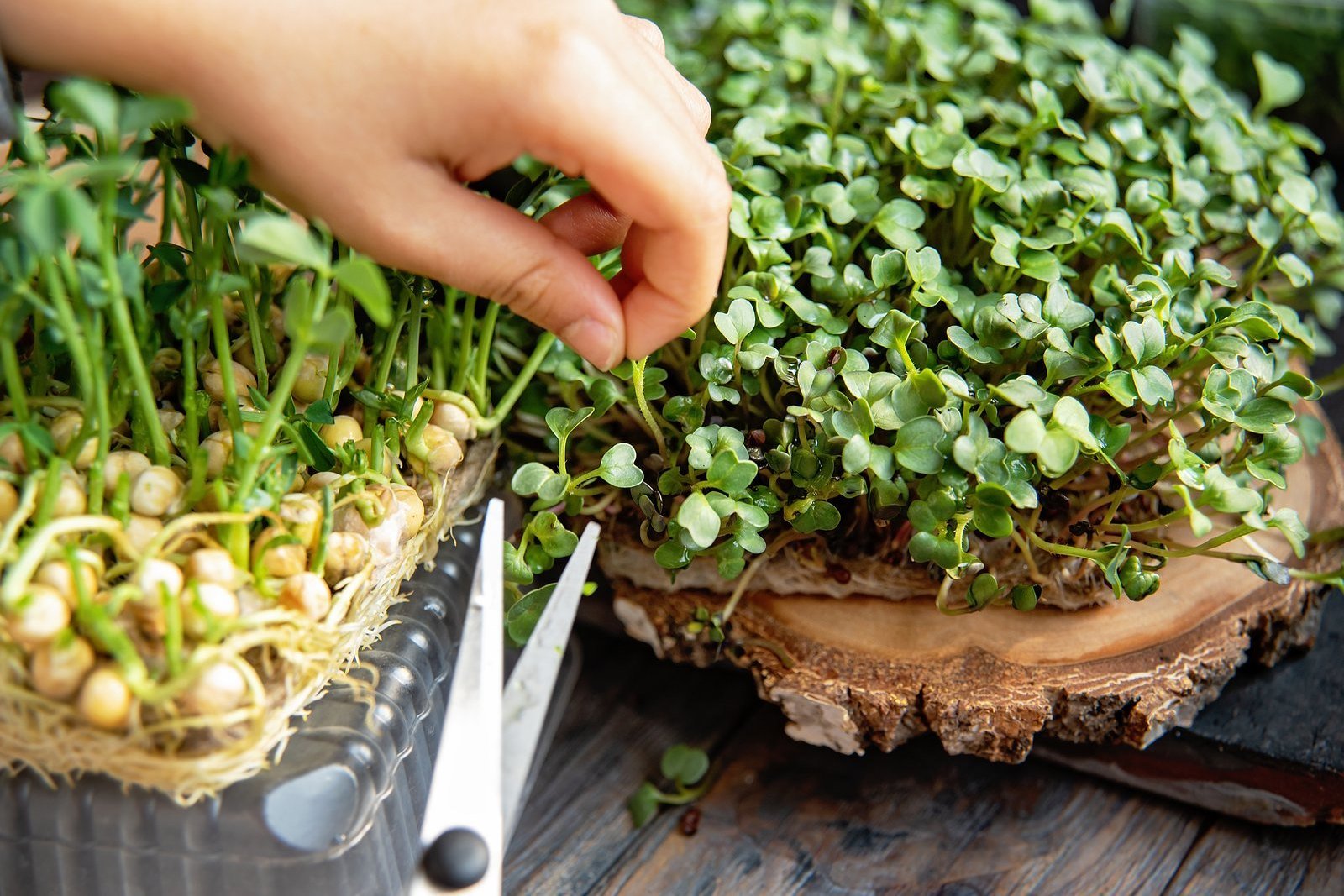
Cut what you need, then rinse only that portion. Some growers sell living trays or containers that you harvest at home. Penn State describes containers of microgreens that growers can sell without harvesting (Sánchez & Berghage, 2025).
With a living tray, timing is easy. Penn State’s home growing guide says to harvest with a clean, sharp knife or pair of scissors right before you use the greens (Di Gioia, 2026). New Mexico State University explains why. Cutting is a big stress on the plant, and cut microgreens are wounded plants that spoil sooner. If you can, wait to cut until you are ready to eat (New Mexico State University, n.d.).
Cut above the growing mix so you leave the roots and soil behind. Hold the cut bunch over a bowl and shake off loose bits of mix or seed hulls. Then rinse and dry it the same way as greens from a pack.
Don’t pour water over the whole tray to clean it. That wets the greens you are saving for later. Keep caring for the tray the way the grower told you.
Do pre-washed or farm-fresh microgreens need washing?
It depends on the label. The FDA says many packaged produce items are pre-washed and ready to eat. If the package says so, you can use the produce without washing it again (U.S. Food and Drug Administration, 2024). If you choose to rewash it anyway, keep it away from unclean surfaces and utensils to avoid cross contamination.
Farm-fresh microgreens may not be washed at all, and Penn State says that is the better practice. It tells growers that washing microgreens before selling them shortens their post-harvest life, and it advises telling buyers to wash them before eating (Sánchez & Berghage, 2025). A second Penn State article says growers should skip post-harvest washing except when absolutely necessary, since it can spread contamination (Stoltzfus & Fronk, 2025).
So if a pack from a market or a local farm has no “pre-washed” or “ready to eat” label, plan to rinse it at home. Not sure? Ask the grower how they handle it. You can find growers near you in the Microgreens 411 directory and ask them directly.
Wrap-up: how to wash microgreens, in short
Washing microgreens is quick once you know the steps. Wait until you are ready to eat. Take out one portion, rinse it gently under cold running water and pat or spin it dry. Skip soap, detergent and produce wash, since plain water is the FDA’s advice.
Living trays work the same way: cut first, then rinse what you cut. Packs labeled ready to eat can go straight to the plate.
Want greens fresh from a nearby farm? Search your town in the Microgreens 411 directory to find growers near you. Coverage varies by region, so some areas have few listings so far.
Microgreens 411
Find a microgreens grower near you
Greens that travel less start fresher in your fridge. Find my local grower →
Frequently asked questions
Does washing remove all germs from microgreens?
No. The FDA says washing can reduce bacteria on produce but will not eliminate it (U.S. Food and Drug Administration, 2024). In a USDA lab study, radish seeds deliberately contaminated with E. coli O157:H7 grew into microgreens carrying the bacteria on the whole plant, including the parts people eat (Xiao et al., 2015).
Should you wash your hands before washing microgreens?
Yes. The FDA advises starting with clean hands, washed for at least 20 seconds with soap and warm water before and after you prepare fresh produce (U.S. Food and Drug Administration, 2024). The agency adds that cutting boards, utensils and counters need soap and hot water after contact with raw meat, poultry or seafood.
What should you do with slimy or bruised microgreens?
Sort them before you rinse. The FDA advises cutting away damaged or bruised parts of produce and throwing away anything that looks rotten (U.S. Food and Drug Administration, 2024). With microgreens, that means picking out the wilted or slimy strands. If much of the pack looks that way, toss it.
Is soaking microgreens better than rinsing them?
We found no study that compares the two for microgreens. In the Tennessee State study, soaking in tap water for 2 minutes before rinsing significantly reduced bacteria on lettuce, but not on broccoli (Kilonzo-Nthenge et al., 2006). If you soak, use a clean bowl and fresh water.
Does cooking microgreens make them safer?
Yes, heat helps. The FDA says cooking produce thoroughly kills harmful bacteria and reduces the risk of illness (U.S. Food and Drug Administration, 2024). If you plan to eat microgreens raw, a careful wash is the safety step you have at home.
What kind of water should you use?
Use clean tap water that is safe to drink. A Penn State guide for home growers recommends washing microgreens in fresh drinking water before you eat them (Di Gioia, 2026). Growers who must wash are told to use clean water treated to remove generic E. coli (Stoltzfus & Fronk, 2025).
References
Di Gioia, F. (2026, September 20). A step-by-step guide for growing microgreens at home. Penn State Extension. https://extension.psu.edu/a-step-by-step-guide-for-growing-microgreens-at-home
Kilonzo-Nthenge, A., Chen, F.-C., & Godwin, S. L. (2006). Efficacy of home washing methods in controlling surface microbial contamination on fresh produce. Journal of Food Protection, 69(2), 330–334. https://doi.org/10.4315/0362-028x-69.2.330
New Mexico State University. (n.d.). Eating microgreens. All About Microgreens. https://all-about-microgreens-d.nmsu.edu/consumers.html
Priti, Sangwan, S., Kukreja, B., Mishra, G. P., Dikshit, H. K., Singh, A., Aski, M., Kumar, A., Taak, Y., Stobdan, T., Das, S., Kumar, R. R., Yadava, D. K., Praveen, S., Kumar, S., & Nair, R. M. (2022). Yield optimization, microbial load analysis, and sensory evaluation of mungbean (Vigna radiata L.), lentil (Lens culinaris subsp. culinaris), and Indian mustard (Brassica juncea L.) microgreens grown under greenhouse conditions. PLOS ONE, 17(5), e0268085. https://doi.org/10.1371/journal.pone.0268085
Sánchez, E., & Berghage, R. (2025, December 16). Growing microgreens. Penn State Extension. https://extension.psu.edu/growing-microgreens
Stoltzfus, J., & Fronk, L. (2025, July 29). Ensuring food safety in microgreens production. Penn State Extension. https://extension.psu.edu/ensuring-food-safety-in-microgreens-production
U.S. Food and Drug Administration. (2024, March 5). Selecting and serving produce safely. https://www.fda.gov/food/buy-store-serve-safe-food/selecting-and-serving-produce-safely
Xiao, Z., Bauchan, G., Nichols-Russell, L., Luo, Y., Wang, Q., & Nou, X. (2015). Proliferation of Escherichia coli O157:H7 in soil-substitute and hydroponic microgreen production systems. Journal of Food Protection, 78(10), 1785–1790. https://doi.org/10.4315/0362-028X.JFP-15-063