
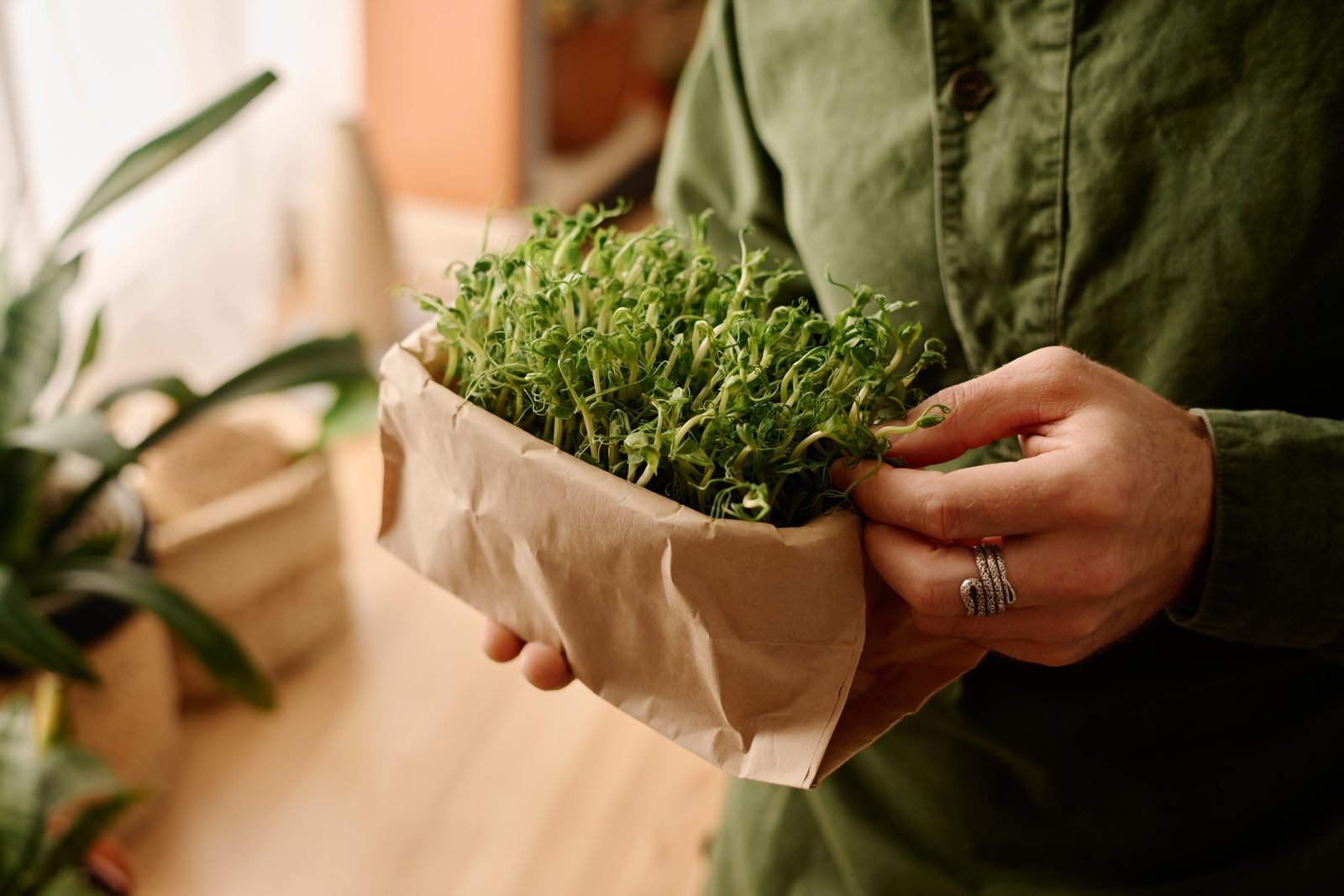
You can get fresh microgreens without leaving the house.
Local farms drop them at your door, some on a weekly schedule. Other growers pack them in a cold box and ship them overnight. Grocery apps bring store packs from a supermarket nearby. Each route treats the greens a little differently on the way to you, and that shapes how long they last in your fridge. This guide explains how microgreens delivery works, what to ask before you order and what to check when the box shows up at your door.
Key Takeaway
Choose the shortest, coldest trip. Penn State says cold, dark storage at 5°C (41°F) can stretch microgreen shelf life to 10 to 14 days, against 2 to 4 days at room temperature (Sánchez & Berghage, 2025). Local delivery from a nearby farm keeps that trip short.
Below: the main delivery options, local farm drop-offs, subscriptions, shipped boxes, the trip from tray to door, and a checklist for ordering.
Microgreens 411
Find a microgreens grower near you
Greens that travel less start fresher in your fridge. Find my local grower →
Table of Contents
- How does microgreens delivery work?
- Is local farm delivery the freshest option?
- How do microgreens subscriptions work?
- Can you get microgreens shipped to your door?
- What happens to microgreens between harvest and your door?
- What should you check before ordering microgreens delivery?
- Wrap-up: getting microgreens delivery right
- Frequently asked questions
- References
How does microgreens delivery work?

There are four common routes: a local farm that drops orders off, a farm subscription, a grower who ships by mail and a grocery delivery app. They differ mostly in distance and in how cold the greens stay on the way.
A local farm usually delivers on set days to nearby towns. A subscription works the same way on a fixed schedule, often weekly or every other week. Shipping covers longer distances and depends on cold packs and fast transit. Grocery apps send a shopper to a store, so you get the same sealed packs you would find in the produce case.
Microgreens have a short shelf life once they are cut, which is why most sellers stay local (Sánchez & Berghage, 2025). Shipping fills in where no farm delivers, and grocery apps fill in when you need greens tonight.
The table compares the four routes side by side. If you’d rather shop in person, our guide to where to buy microgreens covers stores, markets and farm pickup.
| Delivery route | What to expect |
|---|---|
| Local farm drop-off | Set delivery days, short trip |
| Farm subscription | Regular boxes, often prepaid |
| Shipped by mail | Cold packs, overnight transit |
| Grocery delivery app | Store packs from a nearby store |
Is local farm delivery the freshest option?
Often, yes. The trip from the farm is short, and short trips keep greens cold. Penn State says microgreens are ideally taken to market right after harvest (Sánchez & Berghage, 2025). A farm a few miles away can do that.
Here is one real example. Wind River Greens grows in Milton, Georgia, about 8 miles from Roswell, and delivers there every Sunday. Its weekly bundle costs $25. Delivery is free for subscribers and $5 for one-time orders over $25 (Wind River Greens, n.d.). Another farm, Spring Lake Farm in Minnesota, says its boxes arrive within 24 hours of harvest (Spring Lake Farm, n.d.).
Those two show what to look for in microgreens delivery from a farm. Ask how far away it grows and which days it delivers. Then ask how many hours pass between cutting and drop-off, since that number tells you the most.
Local delivery has limits. Most farms serve only nearby towns, and many set an order minimum or charge a fee. The Microgreens 411 directory can show which growers deliver to your town.
How do microgreens subscriptions work?
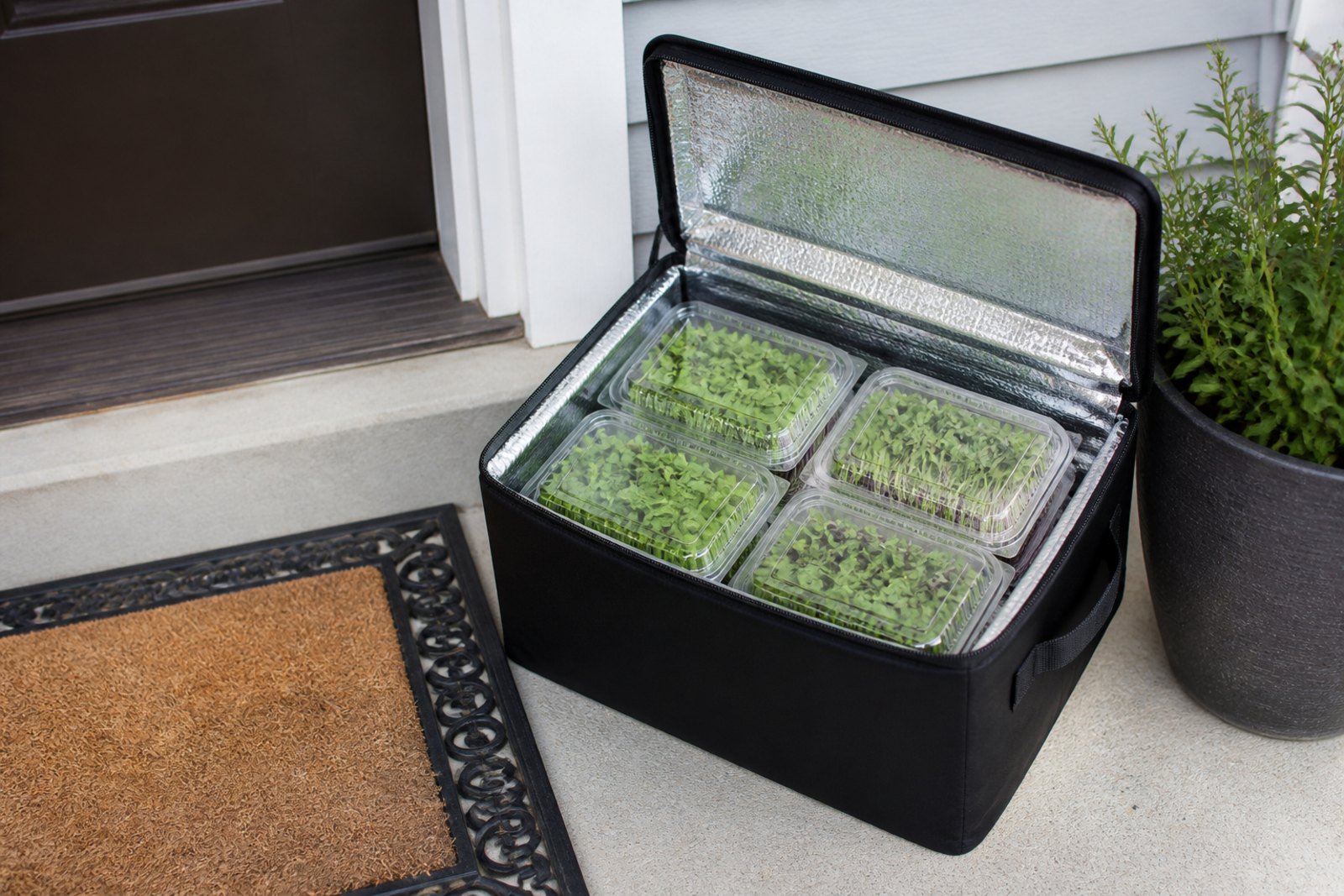
You sign up once and the farm sends greens on a schedule. The USDA describes community supported agriculture, or CSA, as regular, usually weekly, deliveries from a farm. Customers pay part or all of the cost up front (U.S. Department of Agriculture, Agricultural Marketing Service [USDA AMS], n.d.).
Microgreen subscriptions follow the same idea on a smaller scale. Spring Lake Farm’s spring box, for example, brings $15 or $20 worth of microgreens every other week, five deliveries over ten weeks. It is pre-ordered, and all sales are final (Spring Lake Farm, n.d.).
That last detail matters. Read the terms before you pay. Check whether you can skip a week when you travel, pause for a month or cancel. Ask whether a missed delivery gets refunded or rescheduled.
Subscriptions lock in a routine. Fresh greens show up whether or not you used the last batch. Pick a size you will finish, since microgreens delivery only pays off if the greens get eaten. Start small and scale up once you know how fast your household goes through a box.
Can you get microgreens shipped to your door?
Yes. Some growers ship cut microgreens in insulated boxes to buyers far from any farm. Shipping is the riskiest route, so packing and timing matter most. A box that warms up in transit loses part of its shelf life.
USDA food safety guidance for mail-order food says perishable items should ship cold, packed with a cold source in foam or heavy cardboard, and ideally overnight. When the box arrives, open it right away. Food marked “Keep Refrigerated” should be at least refrigerator cold, below 4°C (40°F) on a food thermometer (U.S. Department of Agriculture, Food Safety and Inspection Service [USDA FSIS], 2015).
If the food arrives warm, above 4°C (40°F), tell the company and do not eat it, the USDA says. Do not even taste it (USDA FSIS, 2015).
Timing helps too. The same guidance advises against having perishables delivered to an office, except on a work day when someone can put them in a fridge (USDA FSIS, 2015). Order microgreens delivery for a day you are home, early in the week if you can. That keeps the box from sitting over a weekend.
What happens to microgreens between harvest and your door?
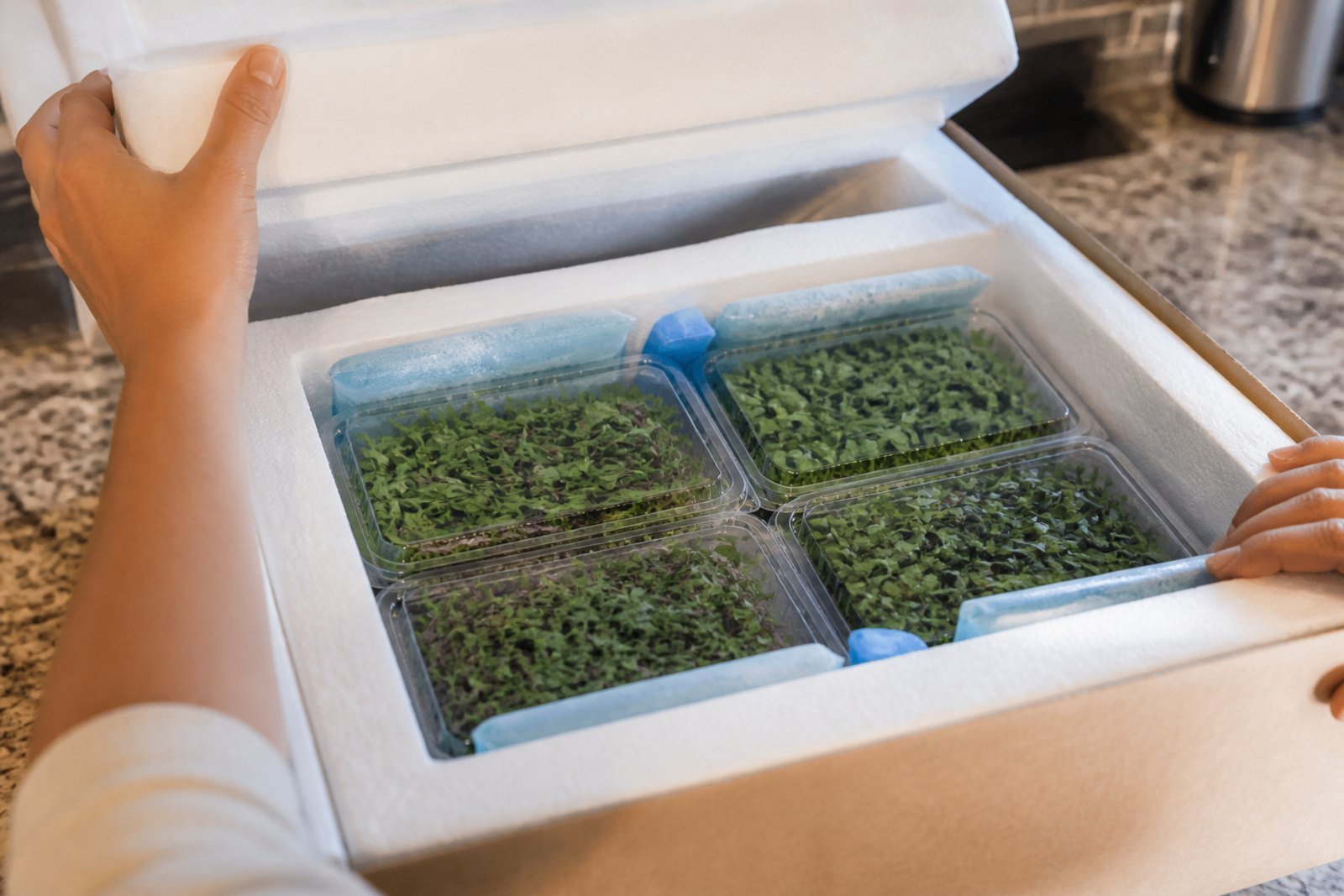
The clock starts at the cut. Penn State reports that storing microgreens at 5°C (41°F) in the dark can extend shelf life to 10 to 14 days, against 2 to 4 days at room temperature (Sánchez & Berghage, 2025).
Steady cold matters as much as cold. Penn State says changing temperatures can cause condensation, and that moisture shortens post-harvest life. Washing them before sale shortens their life too, which is why Penn State tells growers to have buyers rinse them at home instead (Sánchez & Berghage, 2025).
So a good microgreens delivery service keeps the greens cold from cutting to your step, without warm stops in between. A cooler bag on a hot porch does not count. Neither does a van that sits in the sun between drop-offs, so ask how the grower keeps the load cold on the route.
Once the box is inside, put the greens straight into the fridge. Our storage guide covers containers and fridge placement. For how many days you have left, see our shelf life guide.
What should you check before ordering microgreens delivery?
Ask five things before you pay. Each one is quick to answer, and a good grower will answer them all without fuss. Many farms post these answers on their order page, so check there first.
First, ask when the greens are cut. A grower who harvests the day before delivery, or the same morning, gives you more fridge days. Second, ask about the delivery window and whether someone needs to be home. Third, ask how the greens are packed: in a cooler, with ice packs, or in an insulated box for shipping.
Fourth, check the costs. Look for an order minimum, a delivery fee and whether subscribers get a better rate. Fifth, read the terms on skips, pauses, refunds and cancellations, especially for prepaid boxes.
On delivery day, check the box when it lands. The greens should feel cold, the pack should be dry inside, and nothing should look bruised or slimy. If anything looks off, contact the grower the same day with a photo.
Wrap-up: getting microgreens delivery right
Pick the shortest, coldest trip you can get. A local farm or subscription usually beats shipping on freshness, and shipping works when it arrives cold and fast. Ask about cut times, delivery windows, packing and terms before you order, and check the box as soon as it arrives.
Then get the greens into the fridge and use them in the first few days, when they are at their best. If a delivery ever shows up warm or wet, say so. Good growers want to know.
To see which growers deliver near you, search your town in the Microgreens 411 directory and switch the view to growers who deliver there.
Microgreens 411
Find a microgreens grower near you
Greens that travel less start fresher in your fridge. Find my local grower →
Frequently asked questions
How long can a delivery box sit on the porch?
Not long. USDA guidance says perishable food should not sit between 4°C (40°F) and 60°C (140°F) for more than 2 hours, and bacteria can grow without changing taste, smell or looks (USDA FSIS, 2015). If you’ll be out, ask the grower for a later drop-off.
Who can you contact if a shipment arrives warm?
Start with the seller. The USDA lists the FDA Outreach and Information Center, at 1-888-723-3366 on weekdays, for questions about foods other than meat, poultry and eggs (USDA FSIS, 2015). Keep the box and take photos before you call.
Can you get living microgreens delivered?
Yes, from some growers. Copper Dog Farms in Palm Springs, California, delivers live microgreens locally so customers can cut them fresh at home (Copper Dog Farms, n.d.). Penn State notes that trays take more room to transport than cut greens (Sánchez & Berghage, 2025), so expect a smaller delivery area.
Do microgreen subscriptions run all year?
Not always. Some run only for a season. The Spring Lake Farm box mentioned above runs from early April through late May (Spring Lake Farm, n.d.). Ask whether a subscription renews on its own and what happens to deliveries when the season ends.
Why do some growers ask you to order days ahead?
Many grow to order. Penn State says microgreens take 7 to 21 days from seeding to harvest, depending on the crop and the growing setup (Sánchez & Berghage, 2025). A grower planning trays for your order may need that lead time for the kinds you want.
Can you send microgreens as a gift?
Yes, with a heads-up. USDA mail-order guidance says to tell the recipient the delivery date the company promised, or warn them the gift is on its way, so someone is there to get it cold (USDA FSIS, 2015). Local farms that deliver may take gift orders too.
References
Copper Dog Farms. (n.d.). Copper Dog Farms: Microgreens. Retrieved October 30, 2026, from https://copperdogfarms.com/
Sánchez, E., & Berghage, R. (2025, December 16). Growing microgreens. Penn State Extension. https://extension.psu.edu/growing-microgreens
Spring Lake Farm. (n.d.). Home delivery spring microgreen box. Retrieved October 30, 2026, from https://www.springlakefarmstore.com/microgreen-spring-box
U.S. Department of Agriculture, Agricultural Marketing Service. (n.d.). Local food directory listings. Retrieved October 30, 2026, from https://www.ams.usda.gov/services/local-regional/food-directories-listings
U.S. Department of Agriculture, Food Safety and Inspection Service. (2015, March 30). Mail order food safety. https://www.fsis.usda.gov/food-safety/safe-food-handling-and-preparation/food-safety-basics/mail-order-food-safety
Wind River Greens. (n.d.). Microgreens delivery in Roswell, GA. Retrieved October 30, 2026, from https://windrivergreens.com/pages/roswell