
Microgreens are easier to find than most people think.
They sit in grocery store produce cases and on farmers market tables. They come in farm subscription boxes, and some small growers cut them to order. The catch is that each source sells a different product. A sealed store pack may have spent days on a truck. A local grower’s pack may have been cut that morning. Knowing the difference helps you pick the right stop. This guide covers where to buy microgreens and how to find the growers near you.
Key Takeaway
Grocery stores, farmers markets and farm subscriptions all sell microgreens, though restaurants buy the most (Sánchez & Berghage, 2025). Stores are the easy option. For the freshest pack, buy from a grower near you, since fewer days in transit leaves more days in your fridge.
Below: the main places to buy, what stores carry, how to buy from a grower, how to find one, which kinds are easy to get, and seeds versus ready-to-eat greens.
Microgreens 411
Find a microgreens grower near you
Greens that travel less start fresher in your fridge. Find my local grower →
Table of Contents
- Where can you buy microgreens near you?
- Do grocery stores sell microgreens?
- How do you buy microgreens straight from a grower?
- How do you find microgreens growers in your area?
- Which microgreens are easiest to find?
- Should you buy microgreens seeds or ready-to-eat greens?
- Wrap-up: where to buy microgreens near you
- Frequently asked questions
- References
Where can you buy microgreens near you?
Start with four common sources: grocery stores, farmers markets, farm subscriptions and growers who sell straight from the farm. Penn State Extension says restaurants are the main market for microgreens. Home cooks still have plenty of options. Microgreens turn up in grocery stores, at farmers markets and in some Community Supported Agriculture (CSA) subscriptions (Sánchez & Berghage, 2025).
Each source trades one thing for another. A store is easy and open late. A grower is closer to the harvest. Microgreens have a short shelf life after cutting, and Penn State points to that as the reason local demand exists in the first place (Sánchez & Berghage, 2025).
Plenty of people already buy them, and many buy often. In a 2021 online survey of 660 US adults, 94% had bought microgreens, and 56% bought them every week (Yeargin et al., 2023, as cited in Kelley, 2025).
The table shows where to buy microgreens and what each stop usually sells. The sections after it take each source in turn, starting with the store down the street.
| Where to buy | What you usually get |
|---|---|
| Grocery store | Sealed packs, often 2 ounces |
| Farmers market | Cut greens, sometimes living trays |
| Farm subscription (CSA) | Regular deliveries from a farm |
| Direct from a grower | Pickup or delivery from a local farm |
Do grocery stores sell microgreens?
Yes, many do. Researchers pricing microgreens for a 2021 study found them in local Georgia grocery stores and on the websites of major US grocery chains (Ricks et al., 2023).
The common size was a 2-ounce package. The study priced packs from $6.49 to $16.99 each, a range set to match what retailers were charging at the time (Ricks et al., 2023). Your store may charge more or less today, so compare the price per ounce. A smaller pack is not always the better deal.
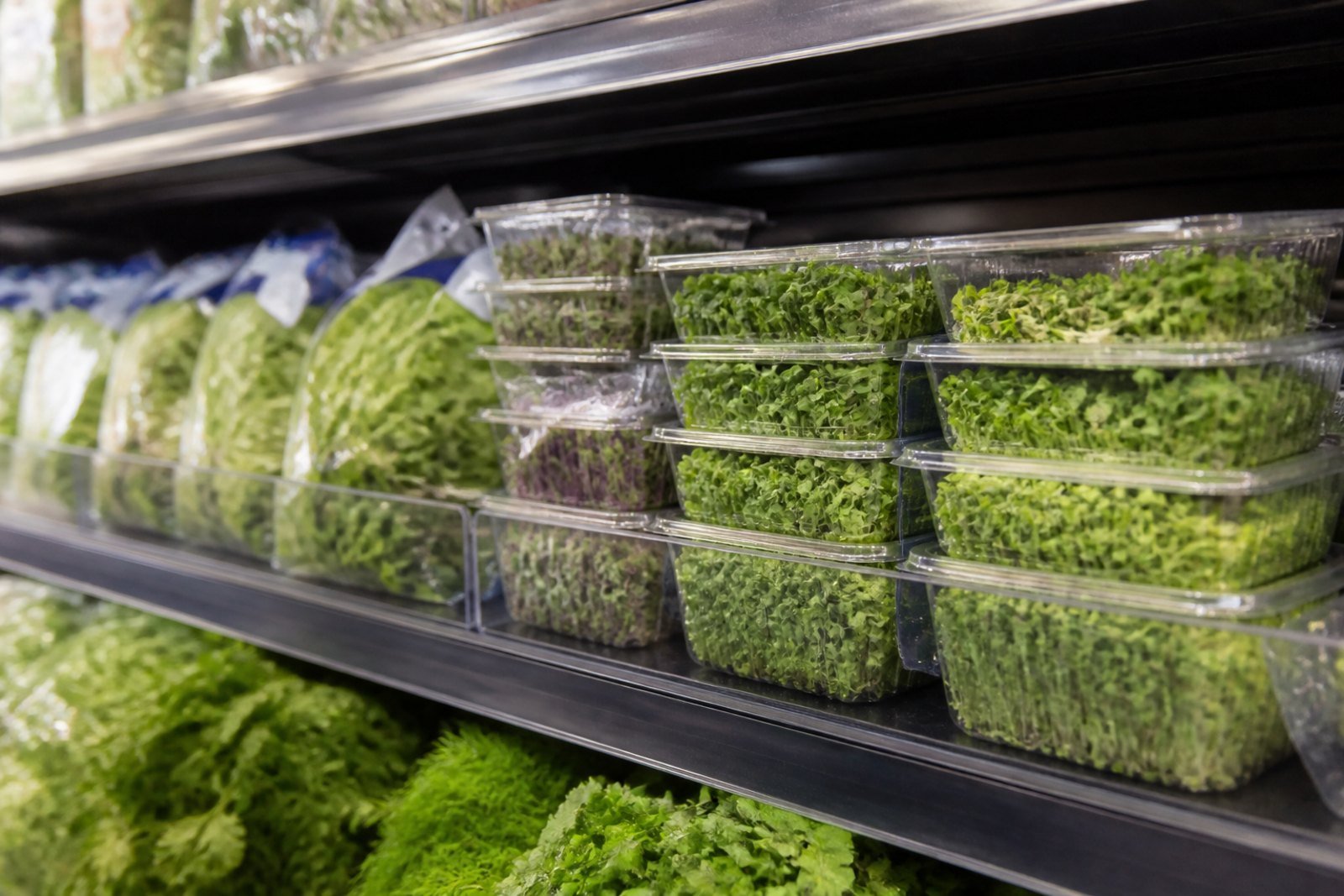
Look in the refrigerated produce case, near the salad greens and fresh herbs. Brands that sell through grocery chains often post a store locator. AeroFarms, a vertical farm, runs one that shows which stores and online shops carry its microgreens (AeroFarms, n.d.).
A store pack is the easy answer to where to buy microgreens on a weeknight. It’s the stop furthest from the grower, so the pack has usually spent the longest time on the road. If your store’s case comes up empty, ask the produce manager whether they can order some.
How do you buy microgreens straight from a grower?
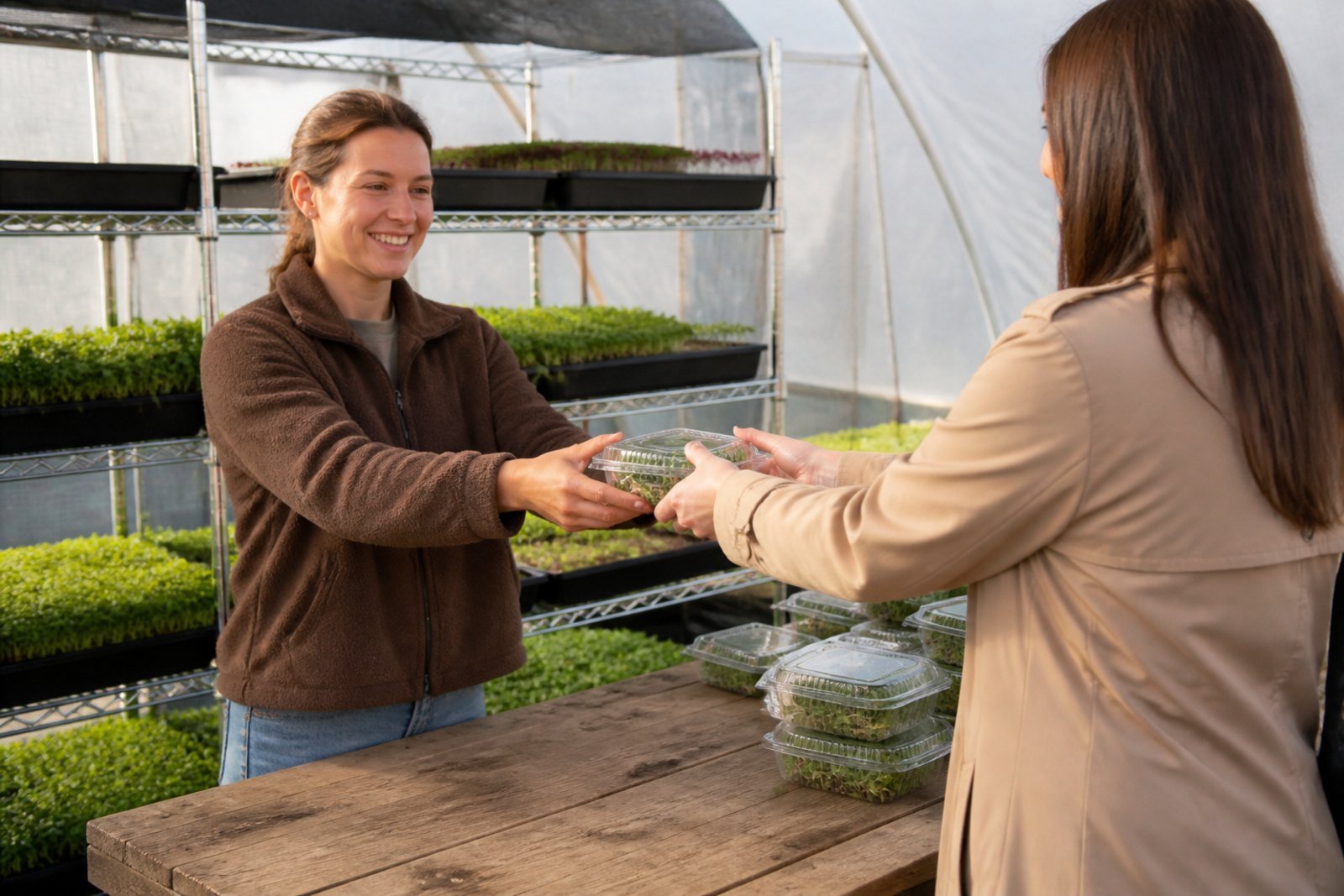
Get in touch with the farm and ask how it sells. Most growers offer one or more of these: pickup at the farm, local delivery, a farmers market stall or a subscription.
Farm pickup is the simplest. The USDA calls this an on-farm market, run by a single farm on or next to its own land and selling straight to the public (U.S. Department of Agriculture, Agricultural Marketing Service [USDA AMS], n.d.). Some growers keep set hours. Others ask you to order ahead.
A subscription, or CSA, works on a schedule. You pay part or all of the cost up front, and the farm sends regular, usually weekly, shares of what it grows (USDA AMS, n.d.). Penn State describes a Pennsylvania farmer who grows microgreens in a high tunnel and sells them to restaurants and through his farm’s vegetable subscription (Sánchez & Berghage, 2025).
Market stalls have their own checklist, covered in our farmers market guide. Home delivery gets its own guide too.
Buying direct means you can ask the grower anything, which is the quickest way to learn where to buy microgreens that suit you.
How do you find microgreens growers in your area?
Search a local directory first, then ask around. The Microgreens 411 directory lists growers by town. You can switch between growers based in a town and growers who deliver there. Coverage varies by region, so some areas have few listings so far.
The USDA runs free Local Food Directories for farmers markets, CSAs, on-farm markets and food hubs. You can search them by zip code and by the products a market or farm sells (USDA AMS, n.d.). A farm that lists vegetables may not list microgreens by name, so call or check its website.
For markets near you, the farmers market finder on our sister site, Microgreens World, searches by state, county or zip code.
Then ask people. Market managers know which vendors bring microgreens. So do produce staff at natural food stores and co-ops. Chefs at local restaurants are another lead, since restaurants are the main market for growers (Sánchez & Berghage, 2025).
A short search like this beats guessing where to buy microgreens from map results alone.
Which microgreens are easiest to find?
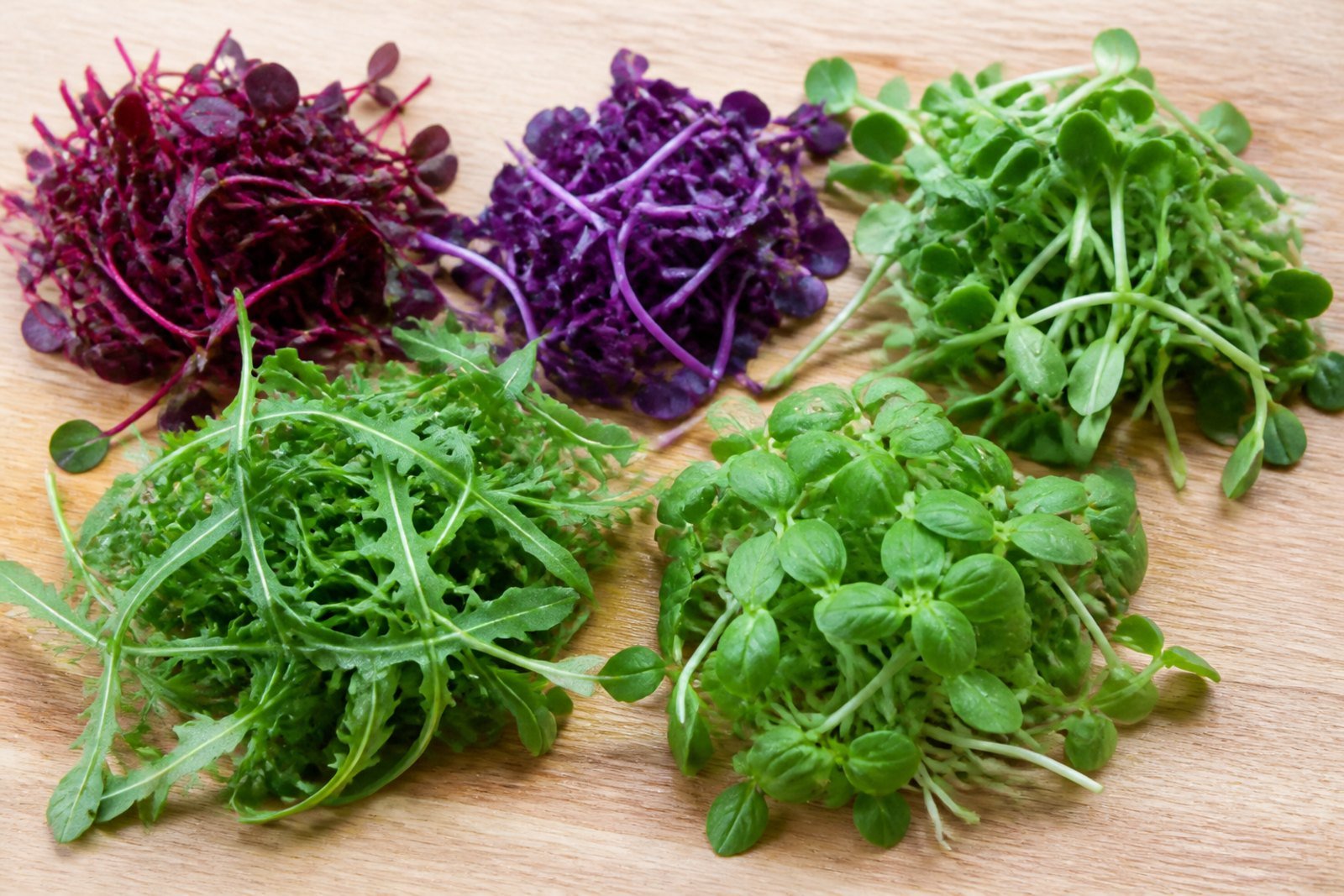
It depends on who grows them near you. We found no national count of which kinds sell most, so treat any “most popular” list with care.
Penn State lists more than 30 plants commonly grown as microgreens. Among them are arugula, basil, beet, cabbage, cilantro, kale, mustard and radish (Sánchez & Berghage, 2025). Seed companies sell many of these in ready-made spicy and mild mixes, so mixed packs are common too. A mix is a handy way to try several kinds at once.
Color plays a part in what growers bring. In a Colorado taste panel, red kinds such as bull’s blood beet, red cabbage and red garnet amaranth scored highest for looks (Michell et al., 2020, as cited in Kelley, 2025). In a separate panel of 80 people, bull’s blood beet earned excellent ratings for flavor, texture, looks and overall quality (Xiao et al., 2015, as cited in Kelley, 2025).
If you want a kind you can’t find, ask a local grower. Knowing where to buy microgreens of one kind often comes down to who will grow it for you. For taste, see our flavor guide.
Should you buy microgreens seeds or ready-to-eat greens?
Buy ready-to-eat greens if you want them this week. Buy seeds if you want to grow your own and can wait a couple of weeks for the first cut. Search results for where to buy microgreens mix the two, so check which one a shop is selling before you order.
Growing takes time. Penn State says microgreens take as little as 7 and up to 21 days from seeding to harvest, depending on the kind and the growing setup (Sánchez & Berghage, 2025). Plenty of buyers do both. In the 2021 survey, 34% of microgreen buyers had grown their own (Yeargin et al., 2023, as cited in Kelley, 2025).
If you do grow them, buy seed sold for microgreens. Penn State says seed not sold for that use should be organic or untreated. Some seed coats stay on the seedling and get eaten, so pesticide-treated seed is best avoided (Sánchez & Berghage, 2025).
Sprouting seed is a different product, grown and eaten in a different way. Our sprouts guide explains how the two differ and why the difference matters.
Wrap-up: where to buy microgreens near you
Grocery stores are the easy stop, and the refrigerated case is where to look. Local growers are closer to the harvest, and you can buy from them at the farm, at a market, by delivery or through a subscription. A directory search, the USDA Local Food Directories and a few questions at your farmers market will turn up most of them.
Pick the source that fits your week. A store pack works for a quick dinner. A local grower works when freshness matters most.
The Microgreens 411 directory is a good place to start. Search your town and see who grows nearby.
Microgreens 411
Find a microgreens grower near you
Greens that travel less start fresher in your fridge. Find my local grower →
Frequently asked questions
Can you use SNAP to buy microgreens?
SNAP covers fruits and vegetables, and it covers seeds and plants that produce food for the household (U.S. Department of Agriculture, Food and Nutrition Service, 2025). Fresh microgreens are vegetables, so they fit the first group. Seed for growing them fits the second. The USDA Local Food Directories show which markets take SNAP (USDA AMS, n.d.).
Are microgreens available all year?
Often, yes. Commercial growers commonly use greenhouses and high tunnels, and Penn State’s own class grows microgreens from August through May with extra lighting (Sánchez & Berghage, 2025). No national survey tracks seasonal supply, so a grower’s winter list may be shorter than its summer one.
Do shoppers pay more for microgreens at a farmers market?
In one study, they said they would. Among 574 shoppers in a 2021 online choice test, a farmers market added $7.52 to what they would pay for a 2-ounce pack, compared with a supermarket (Ricks et al., 2023). That was a survey, not a record of real sales.
Do shoppers care whether microgreens were grown in their state?
Somewhat. In the same 2021 study, shoppers preferred microgreens from their own state over ones labeled as grown in California. They showed no clear preference between home-state and Mexican microgreens (Ricks et al., 2023). Taste was not tested, so this reflects labels, not flavor.
Does it matter if microgreens were grown under lights?
Shoppers in that study did not penalize LED lighting. Packs grown under LEDs drew the same value as sun-grown ones, but packs grown under high-pressure sodium lamps were valued $2.69 lower (Ricks et al., 2023). No trial in that study tested taste or nutrients.
What do the labels on Microgreens 411 listings mean?
Each label marks a check our staff completed. “Ownership verified” means staff checked the grower’s claim to the listing. “Details confirmed” carries the date the grower confirmed the facts. “Sponsored” marks a paid placement, which never changes ranking. A listing without a label has not had that check.
References
AeroFarms. (n.d.). Store locator: Find AeroFarms microgreens at stores near you. Retrieved October 29, 2026, from https://www.aerofarms.com/store-locator/
Kelley, K. (2025, June 4). Marketing microgreens. Penn State Extension. https://extension.psu.edu/marketing-microgreens
Ricks, J., Secor, W., & Campbell, B. L. (2023). Consumer preference for microgreens in the presence of LED lights and information treatments. HortScience, 58(3), 327–332. https://doi.org/10.21273/HORTSCI16948-22
Sánchez, E., & Berghage, R. (2025, December 16). Growing microgreens. Penn State Extension. https://extension.psu.edu/growing-microgreens
U.S. Department of Agriculture, Agricultural Marketing Service. (n.d.). Local food directory listings. Retrieved October 29, 2026, from https://www.ams.usda.gov/services/local-regional/food-directories-listings
U.S. Department of Agriculture, Food and Nutrition Service. (2025, June 4). What can SNAP buy? https://www.fns.usda.gov/snap/eligible-food-items