
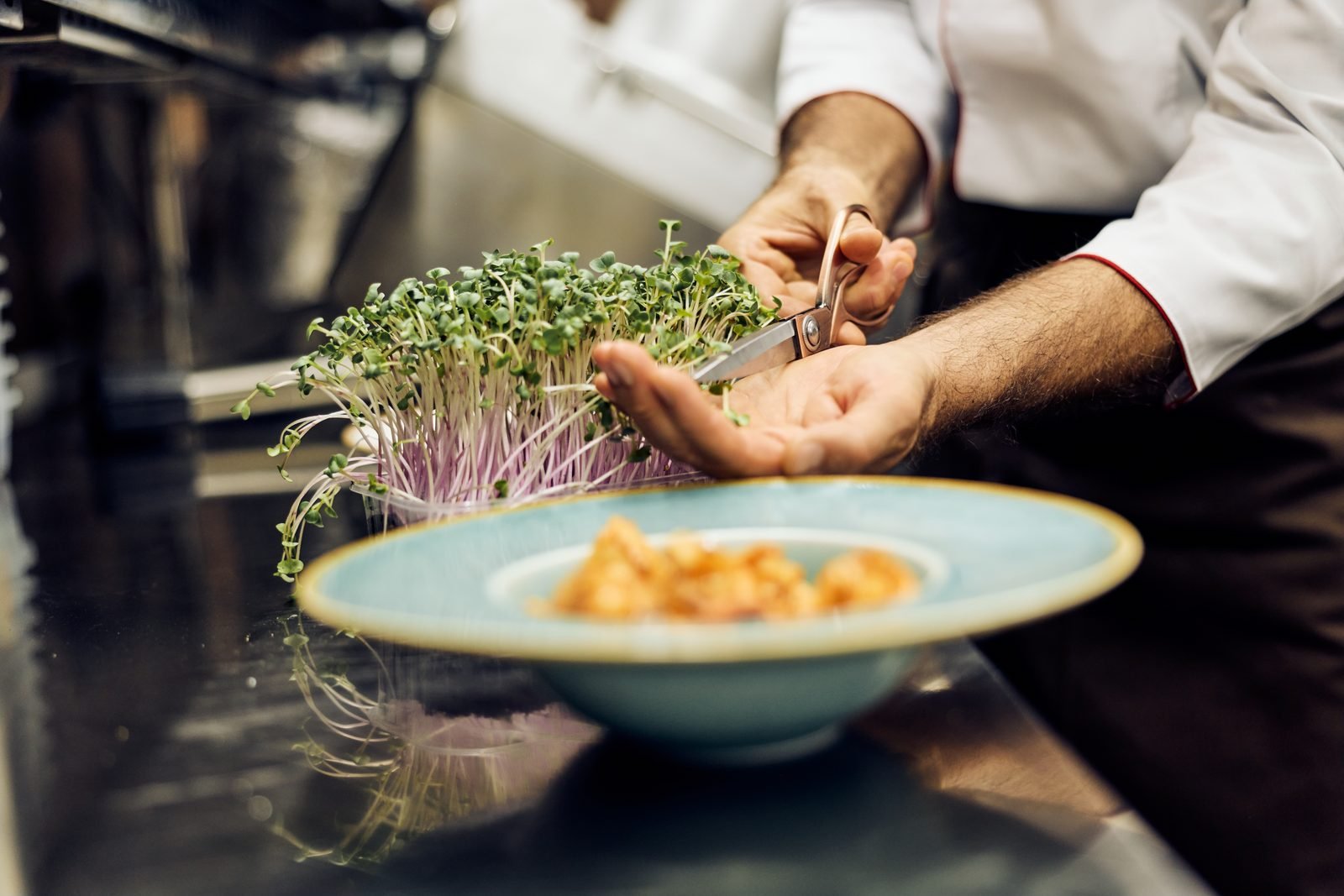
Microgreens can make a plate or sink it.
A chef who serves them every night needs the same greens, cut fresh, on the same day each week. That makes the grower behind them part of the dish. Picking a microgreens supplier for restaurants comes down to a few plain questions. Who grows them, and how close by? What do you pay per pound? What shows up at the back door, and what paperwork stands behind it? This guide walks chefs and buyers through each one, with a source behind every claim.
Key Takeaway
Pick a grower who gives you samples and storage instructions up front (Kelley, 2025), then delivers on a fixed day. Every pack should show the farm name, address and harvest date. Compare prices by the pound. Penn State saw one wholesale sale at $40 per pound, which is one example, not a market rate.
Below: what to look for, local grower or distributor, delivery and standing orders, cut greens or living trays, food safety paperwork, and pricing with red flags.
Microgreens 411
Find a microgreens grower near you
Greens that travel less start fresher in your fridge. Find my local grower →
Table of Contents
- What should you look for in a microgreens supplier for restaurants?
- Should you buy from a local grower or a distributor?
- How do minimums, delivery days and standing orders work?
- Should a kitchen buy cut greens or living trays?
- What food safety paperwork should you ask a supplier for?
- How is wholesale pricing set, and what are the red flags?
- Wrap-up: choosing a microgreens supplier for restaurants
- Frequently asked questions
- References
What should you look for in a microgreens supplier for restaurants?
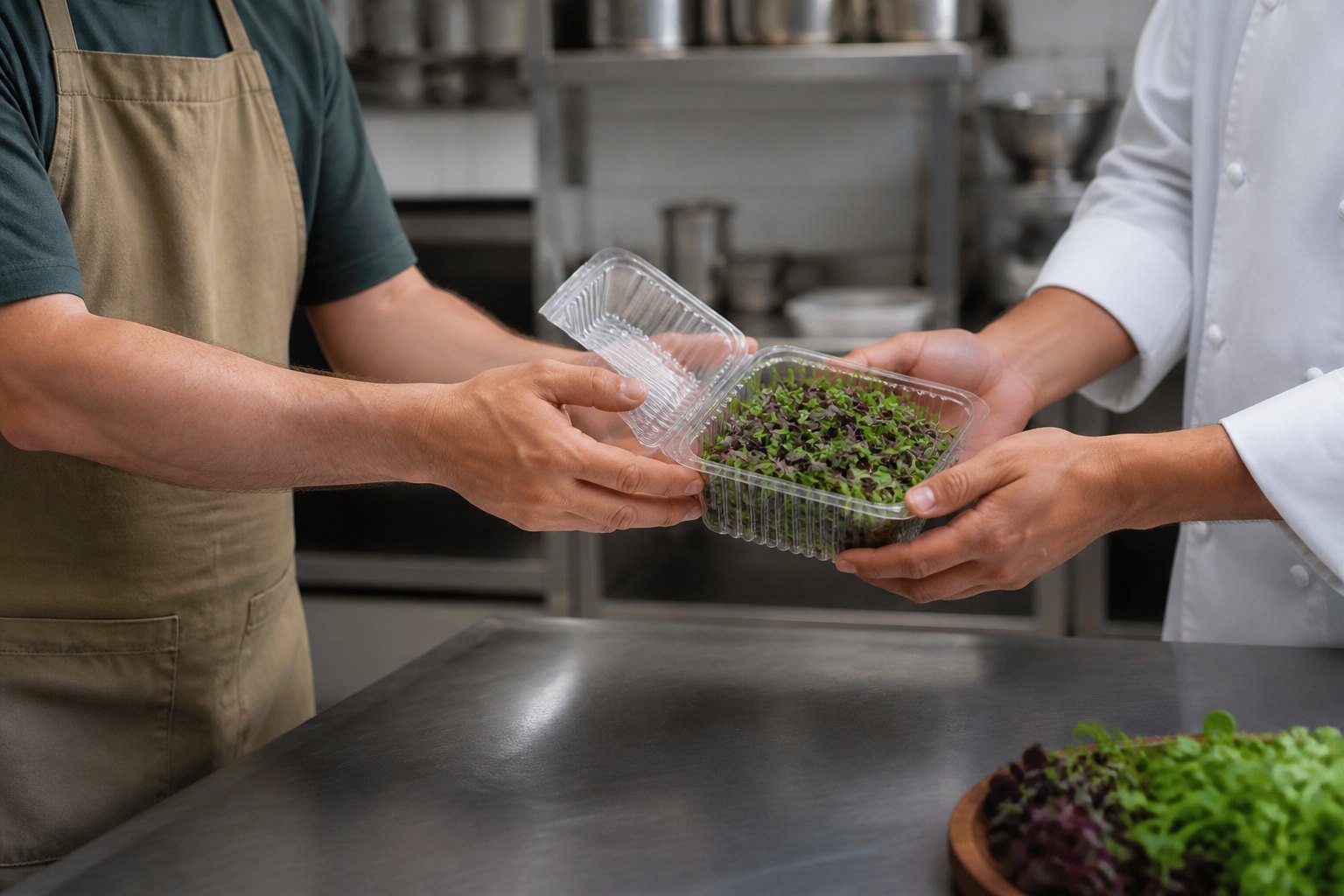
Look for a grower who lets you taste the product first and tells you how to keep it. Penn State Extension tells microgreen growers to win over chefs with small samples, detailed storage and handling instructions, and recipe ideas (Kelley, 2025). Read that from the buyer side. A grower who follows it is doing what the extension service expects. One who won’t send a sample is asking you to buy blind.
Next, ask what they can grow every week, not just what is on the price list. Penn State advises growers to sow one type per tray, since each type sprouts and grows at its own rate. Mixes can be combined after harvest (Sánchez & Berghage, 2025). Ask how they keep a blend the same from one week to the next.
Taste matters too. Peppery radish and mild pea shoots do different jobs on a plate. Our flavor guide sorts the common kinds from mild to hot, so you can build a short list before you call.
The table sums up the first questions to ask.
| Ask the grower | Why it matters |
|---|---|
| Can I get a sample and storage instructions? | Penn State tells growers to offer both to chefs |
| What day do you deliver, and how often? | Your prep plan depends on it |
| Is the farm name, address and harvest date on each pack? | It tells you who grew it and when |
| What is your price per pound? | It lets you compare offers fairly |
Should you buy from a local grower or a distributor?
For freshness, a nearby grower has the edge. Penn State says microgreens have a short post-harvest life, which creates local demand. It names restaurants as the primary market (Sánchez & Berghage, 2025). Fewer days between cut and plate means more usable days in your walk-in.
Cold storage stretches that window but does not erase it. Penn State reports that dark storage at 5°C (41°F) can extend shelf life to 10 to 14 days, against 2 to 4 days at ambient temperature (Sánchez & Berghage, 2025). Every day in a truck or on a warehouse shelf comes out of that total.
Small farms often harvest to order. Wind River Greens, a farm in Milton, Georgia, says on its wholesale page that it harvests to order and offers weekly, every-other-week or custom delivery (Wind River Greens, n.d.). That is one real offer, not a standard.
If you buy through a distributor, ask the same two questions: which farm grew the greens, and on what day were they cut? A good microgreens supplier for restaurants answers both without stalling. If the label can’t tell you, ask for it in writing.
How do minimums, delivery days and standing orders work?
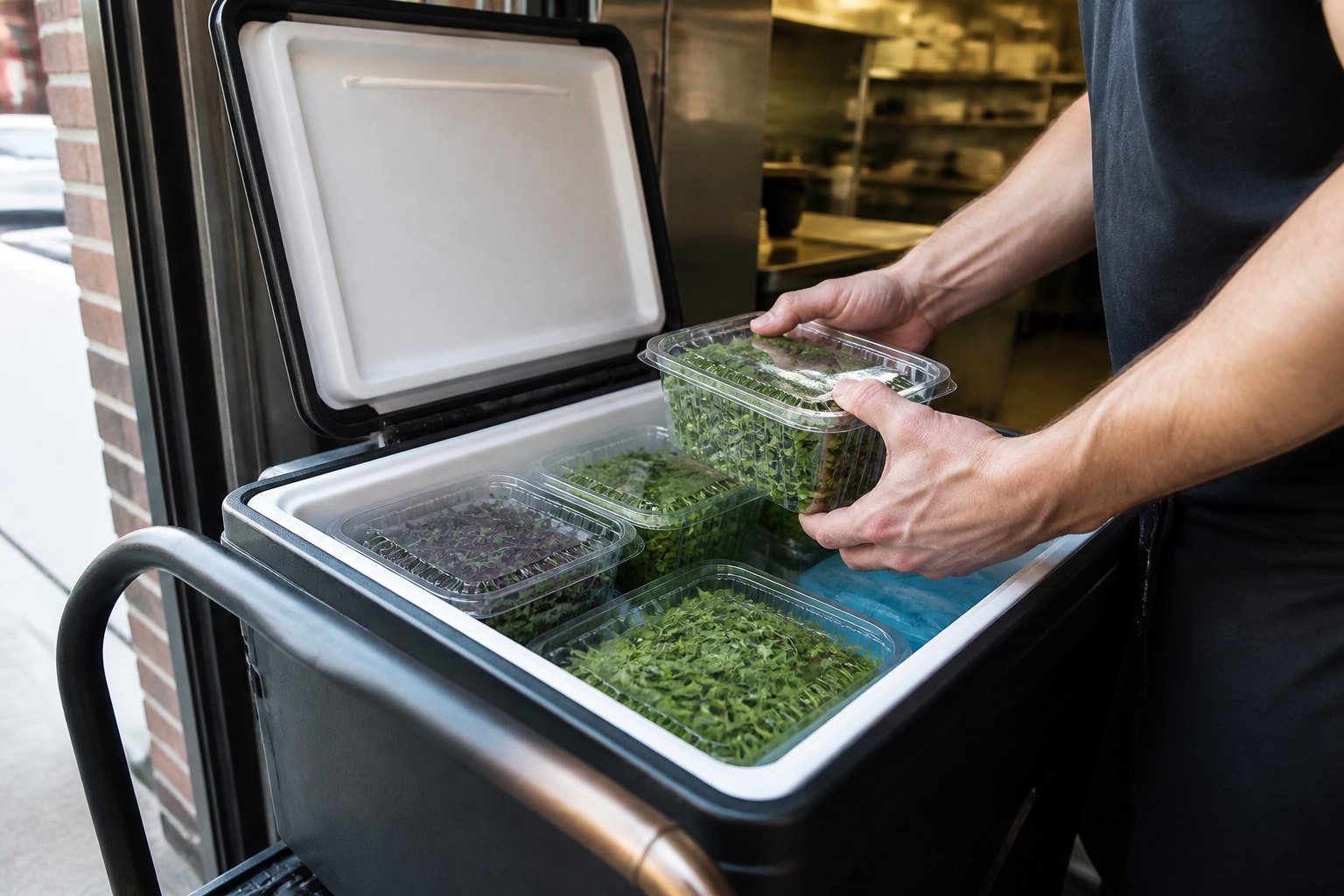
Terms differ from farm to farm, so settle them before your first order. Wind River Greens asks wholesale buyers to estimate weekly volume, with choices from 1 to 2 pounds a week up to 10 pounds or more. It lists bulk pricing for volume orders (Wind River Greens, n.d.). That tells you how a small grower plans: by the pound, week by week.
A standing order fits that rhythm. You agree on varieties, weight and a delivery day, and the grower can plan sowing to match. Microgreens take 7 to 21 days from seeding to harvest, depending on the crop and the growing conditions (Sánchez & Berghage, 2025). So a new item or a big jump in volume needs notice. Ask how much warning the grower needs to add or drop a variety.
Pin down the delivery window too. Ask what time the greens arrive, how they stay cold on the way and who signs for them. Our delivery guide has more on getting microgreens brought to your door.
Not sure who grows near you? The Microgreens 411 directory lists growers by area, so you can contact the ones closest to your kitchen.
Should a kitchen buy cut greens or living trays?
Cut greens save labor in your kitchen. Living trays move the harvest job to your line. Penn State notes that growers can sell microgreens still in their seeding trays, which removes harvest costs but takes more space to transport (Sánchez & Berghage, 2025). That same bulk has to fit in your walk-in.
Harvest is the slow part. Penn State calls it the most time-consuming step. In its course, cutting with scissors took about 4 minutes per tray, and a standard flat gave about 0.30 pounds of greens (Sánchez & Berghage, 2025). Take living trays, and that cutting time lands on your cooks.
The upside of a living tray is that you cut to order, right at plating. If you do, use sharp scissors. Farmers told Penn State that electric clippers and knives tend to tear stems, which shortens post-harvest life compared with scissors (Sánchez & Berghage, 2025).
Whatever format you choose, a microgreens supplier for restaurants should tell you how to hold it until service. Ask for those notes in writing and post them by the walk-in. For plating ideas, our menu guide shows ways to put microgreens to work on the menu.
What food safety paperwork should you ask a supplier for?
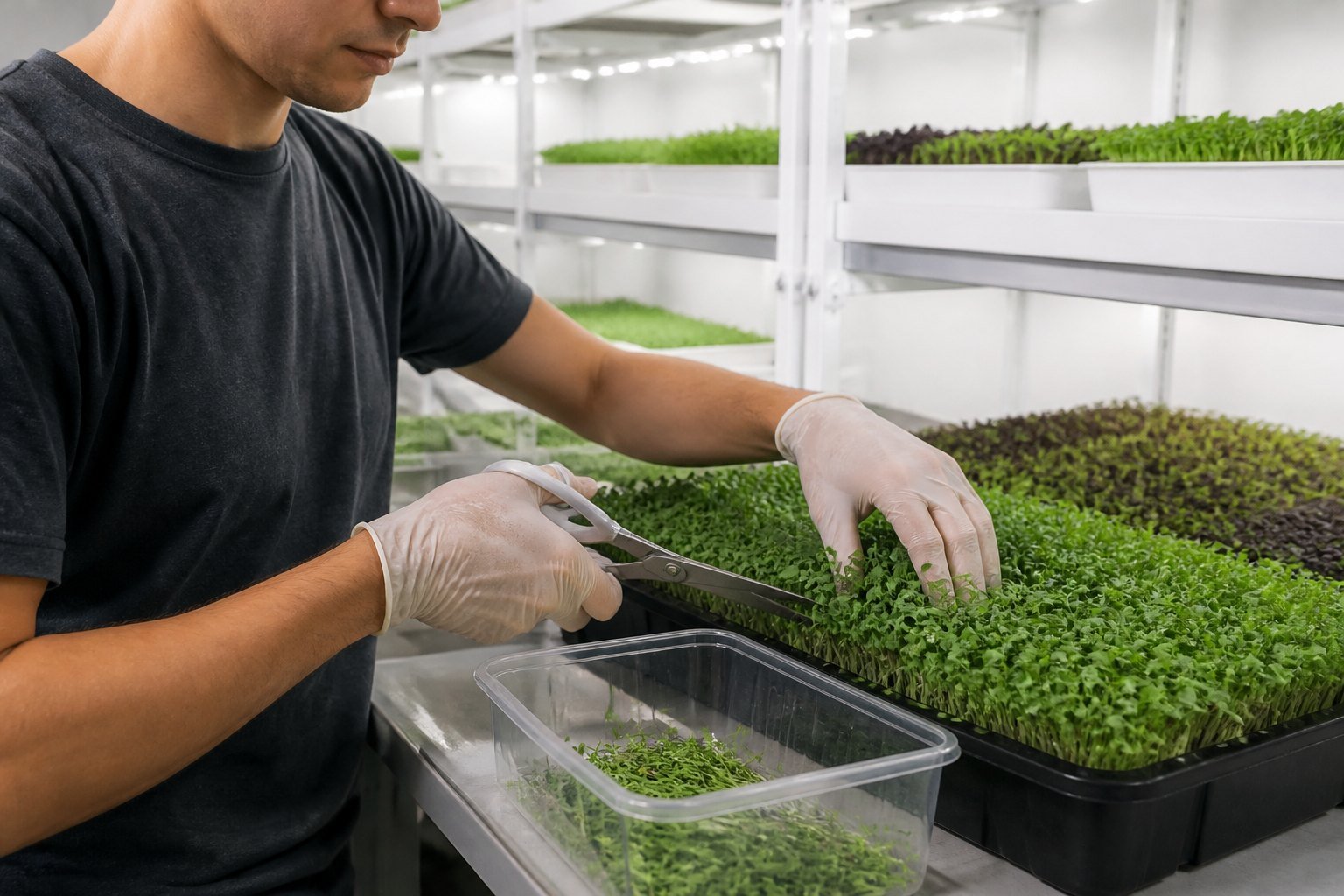
Ask two things: is the farm covered by the federal Produce Safety Rule, and does it hold a GAP audit? Microgreens count as covered produce under the Produce Safety Rule, one of seven rules under the Food Safety Modernization Act (New Mexico State University, n.d.). But the rule does not reach every farm. FDA says farms averaging $25,000 or less a year in produce sales are not covered (U.S. Food and Drug Administration [FDA], 2024).
There is a middle tier. A farm can hold a qualified exemption if its food sales average under $500,000 a year and most of its sales go to qualified end users. A restaurant in the same state, or within 275 miles, counts as one. Such a farm must show its name and full business address on the label or at the point of purchase (FDA, 2024).
GAP is separate. USDA describes GAP audits as voluntary checks that produce is grown, packed, handled and stored to cut microbial risk. Its site has a search for certified companies (U.S. Department of Agriculture, Agricultural Marketing Service [USDA AMS], n.d.). The rule does not require a written farm food safety plan, but NMSU urges growers to write one to meet buyer requirements (New Mexico State University, n.d.). So asking to see one is fair.
How is wholesale pricing set, and what are the red flags?
Price follows the market, so compare offers by the pound. Penn State’s growing guide gives one example: $40 per pound for microgreens sold in 14-gallon totes through a wholesale market. The same guide saw $1.75 for a half-ounce bag sold direct (Sánchez & Berghage, 2025). That bag works out to $56 per pound. Treat both as single examples, not price guides.
Now the red flags. The first is a pack with no farm name, address or harvest date. A University of Nevada, Reno fact sheet tells growers to print all three on final packaging. It says to keep traceability records from seed to delivery too (Moe, 2020).
The second is greens washed at the farm. Penn State says washing before sale shortens post-harvest life, and the Nevada sheet advises against washing on the farm at all (Moe, 2020; Sánchez & Berghage, 2025).
The third is grit. Penn State warns that bits of potting mix are hard to remove, and biting down on perlite can turn customers away (Sánchez & Berghage, 2025). A microgreens supplier for restaurants who sends clean, dry, labeled greens is showing you the care you want.
Wrap-up: choosing a microgreens supplier for restaurants
The right supplier is the one you can count on every week. Start with samples and storage instructions. Settle the delivery day, the weight and the price per pound before the first drop. Ask when the greens were cut and how far they traveled. Check each label for the farm name, address and harvest date, and ask how the farm handles food safety. Then choose cut greens or living trays to fit your space and prep time.
Ready to call around? Search your area in the Microgreens 411 directory to find growers near your kitchen. Coverage varies by region, so some areas have few listings so far.
Microgreens 411
Find a microgreens grower near you
Greens that travel less start fresher in your fridge. Find my local grower →
Frequently asked questions
Do microgreens follow the same rules as sprouts?
No. FDA’s Produce Safety Rule adds extra steps for sprouts, such as testing spent irrigation water from each batch for certain pathogens (FDA, 2024). The Nevada sheet notes that those sprout requirements are not required for microgreen growers, though it calls them worth knowing (Moe, 2020).
Should the kitchen wash microgreens before service?
Yes, right before use. Penn State’s marketing guide says labels should tell buyers to wash microgreens just before use. In one survey, over half of buyers washed them before storage, which can increase microbial growth (Kelley, 2025). Keep them dry in the cooler until then.
Can a restaurant grow its own microgreens instead?
At small scale, yes. Penn State says gardeners grow them on windowsills and decks, and commercial farms use greenhouses and high tunnels. Its course logged about 3.3 minutes per tray just for planting (Sánchez & Berghage, 2025). Count that labor before you clear a shelf.
Which microgreens do diners like the look of?
In one consumer study, red species such as bull’s blood beet, red cabbage and red garnet amaranth had the highest appearance scores. Broccoli and arugula rated acceptable, and tendril pea rated moderately acceptable (Michell et al., 2020, as cited in Kelley, 2025).
Have microgreens been tied to many outbreaks?
Few on record. The Nevada sheet reports no known U.S. foodborne outbreaks linked to microgreens from 1998 to 2017, against over 50 for sprouts and baby greens. It adds that bacteria levels can match sprouts, so safe handling still counts (Colorado State University, 2019, as cited in Moe, 2020).
Should you ask what seed the grower uses?
Yes. Penn State advises organic or untreated seed when it is not sold for microgreens, since some species keep the seed coat, which gets eaten (Sánchez & Berghage, 2025). The Nevada sheet adds that seed can carry pathogens and should come from a partner with a food safety plan (Moe, 2020).
References
Kelley, K. (2025, June 4). Marketing microgreens. Penn State Extension. https://extension.psu.edu/marketing-microgreens
Moe, J. (2020, June). Microgreens and produce safety. Desert Farming Initiative, University of Nevada, Reno. https://naes.unr.edu/dfi/publication.aspx?PubID=3468
New Mexico State University. (n.d.). Growing microgreens. All About Microgreens. https://all-about-microgreens.org/growers.html
Sánchez, E., & Berghage, R. (2025, December 16). Growing microgreens. Penn State Extension. https://extension.psu.edu/growing-microgreens
U.S. Department of Agriculture, Agricultural Marketing Service. (n.d.). Good Agricultural Practices (GAP) audits. https://www.ams.usda.gov/services/auditing/gap-ghp
U.S. Food and Drug Administration. (2024, November 13). FSMA final rule on produce safety. https://www.fda.gov/food/food-safety-modernization-act-fsma/fsma-final-rule-produce-safety
Wind River Greens. (n.d.). Wholesale microgreens. https://windrivergreens.com/pages/wholesale