
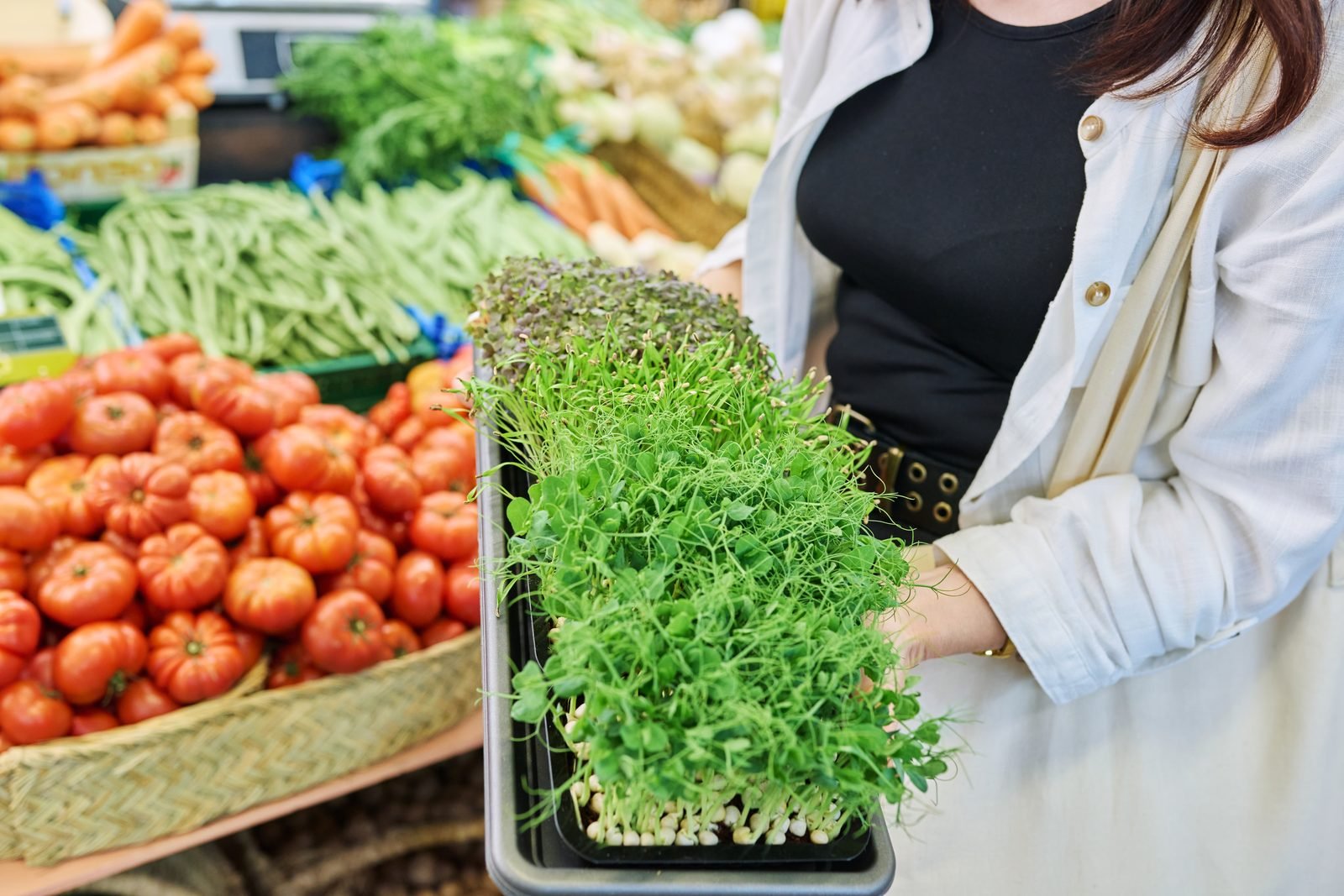
I visit farmers markets regularly, and I don’t always go to buy. I go to see which microgreens are selling and to talk with the growers.
I watch how each market treats new vendors too, and the ones who have sold there for years. A lot of it shows up on the table. Buying microgreens at a farmers market can get you the freshest greens in town. It can just as easily get you a box that sat in the sun all morning. A few quick checks tell you which one you’re holding.
Key Takeaway
Ask when the greens were cut, and buy from a cold display. New Mexico State University says to eat microgreens no later than 3 to 5 days after harvest (New Mexico State University, n.d.-a). So the cut date tells you how many good days are left in the pack. A fair price on a fresh cut beats a bargain cut days ago.
Below: a market checklist, how market greens stack up against the grocery store, what to ask, how the booth should look, what to pay, and how to get them home.
Microgreens 411
Find a microgreens grower near you
Greens that travel less start fresher in your fridge. Find my local grower →
Table of Contents
- What should you look for when buying microgreens at a farmers market?
- Are farmers market microgreens better than grocery store microgreens?
- What should you ask a microgreens grower at the market?
- How should microgreens be displayed at a market booth?
- How much should microgreens cost at a farmers market?
- How do you get farmers market microgreens home fresh?
- Wrap-up: buying microgreens at a farmers market
- Frequently asked questions
- References
What should you look for when buying microgreens at a farmers market?
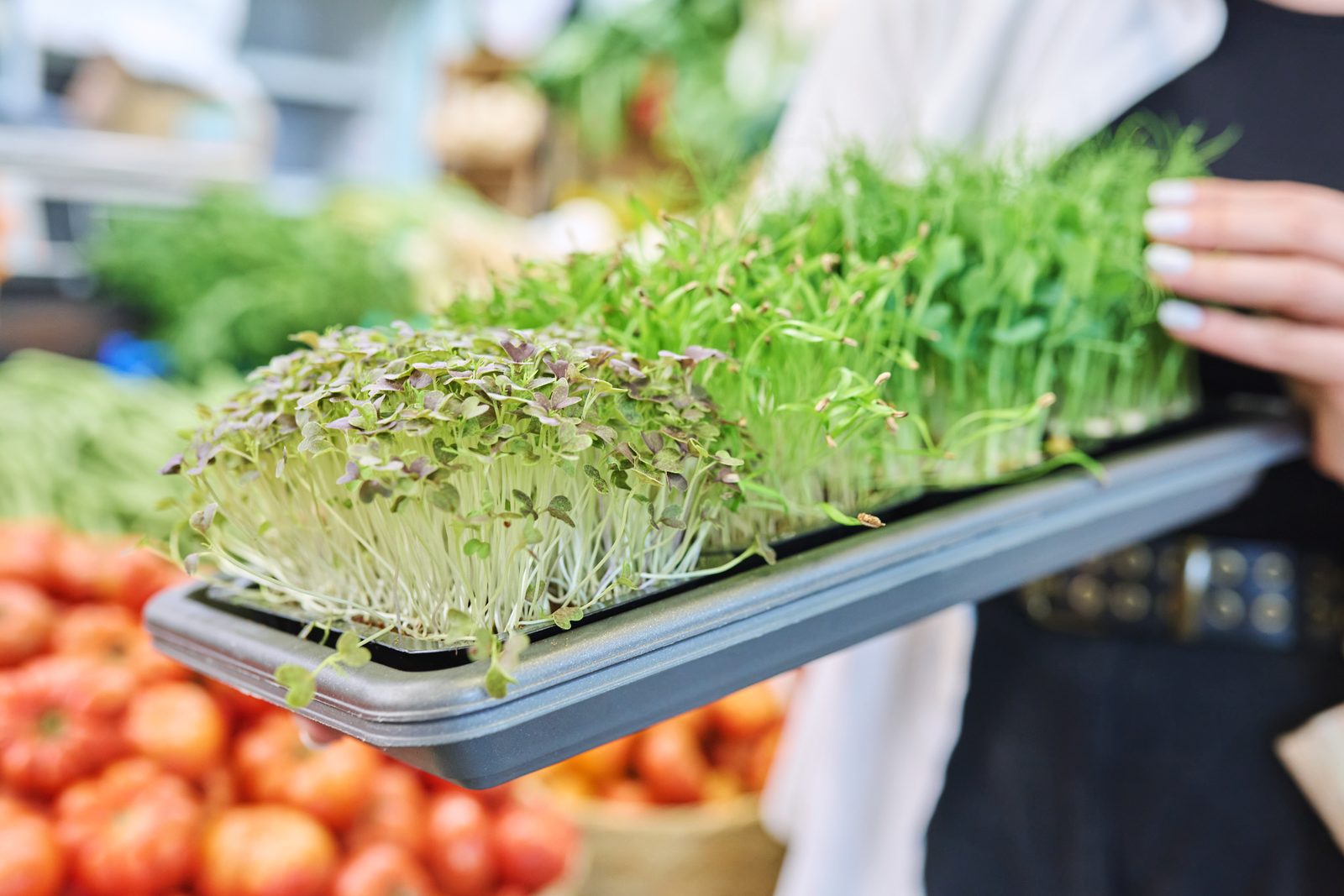
Start with two things on the table: a harvest date and a cold display. Then check the pack itself. It should be dry inside, with the lid on.
The date comes first. Microgreens have a short post-harvest life, so the day they were cut sets the clock (Sánchez & Berghage, 2025). Buyers already know to look. In a survey of 660 US microgreen buyers, 89% said they looked for a use-by or best-by date (Yeargin et al., 2023, as cited in Kelley, 2025).
Market packs don’t always carry a printed date. If yours doesn’t, ask the grower. Any good grower can tell you the cut date on the spot, and a shrug is an answer of its own.
The display tells you how the greens spent the morning. Cold means a cooler, ice or a refrigerated case. Dry means no water pooled in the bottom of the clamshell. The table sums it up. The sections below explain each line, starting with the date, then the grocery store question most shoppers ask next.
| What to check | What you want to see |
|---|---|
| Cut date | On the label, or the grower can tell you |
| Display | In a cooler, on ice, or refrigerated |
| Inside the pack | Dry, with no pooled water, lid closed |
| The greens | Not bruised or damaged |
Are farmers market microgreens better than grocery store microgreens?
In the one taste test that compared them, local won. Researchers had 150 people taste broccoli microgreens from three sources: a grocery store brand grown in water, a local farm’s hydroponic crop and a local farm’s soil-grown crop. The grocery store sample scored lowest on every sensory measure (Chen et al., 2020).
Price mattered less than you might guess. Taste and perceived benefits shaped who planned to buy more than the price tag did (Chen et al., 2020).
Freshness explains a lot of it. Penn State says microgreens are ideally taken to market right after harvest, and their short post-harvest life creates local demand (Sánchez & Berghage, 2025). Fewer days on a truck leaves more days for your kitchen.
Keep the limits in view. That was one crop and one panel, and it compared local farms with a store brand, not market stalls. A market vendor fits the “local” side only if the greens are theirs and grown nearby. When buying microgreens at a farmers market, that’s worth a question, which brings us to the next section.
What should you ask a microgreens grower at the market?
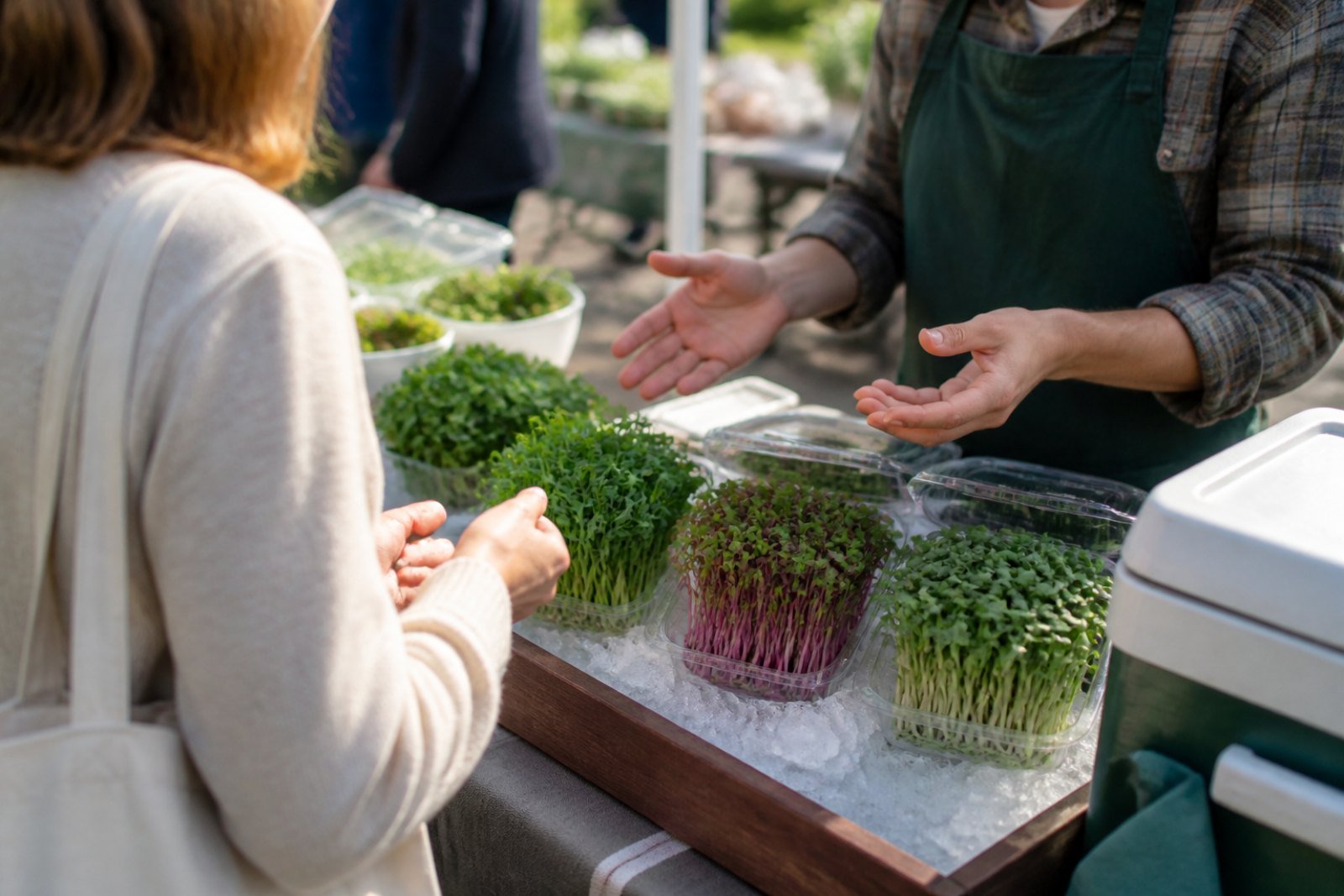
Start with one question: when were these cut? New Mexico State University says to eat microgreens within 3 to 5 days of harvest, so the answer tells you how long the pack will last at home (New Mexico State University, n.d.-a). Count from the cut date, not the day you buy.
Next, ask whether they grew the greens. The taste-test edge above came from local farms. A stall reselling someone else’s crop may not share it.
Then ask whether the greens were washed. Unwashed is normal and a good sign. Penn State notes that washing before sale shortens post-harvest life, and it advises growers to tell buyers to wash just before eating (Sánchez & Berghage, 2025). The FDA says to wash farmers market produce under running water before you eat it (U.S. Food and Drug Administration, 2024). Our washing guide covers the method.
I talk with growers whenever I visit a market. When you’re buying microgreens at a farmers market, asking costs nothing, and a grower who answers fast and plainly knows the crop.
How should microgreens be displayed at a market booth?
Cold and covered. The FDA says to buy pre-cut, bagged or packaged produce only when it’s refrigerated or surrounded by ice (U.S. Food and Drug Administration, 2024). A clamshell of cut microgreens fits that description. A cooler, a tub of ice or a refrigerated case all pass. A stack of boxes on a sunny table does not.
Heat costs days fast. New Mexico State University says microgreens go bad very quickly at room temperature. Cut greens shouldn’t be expected to last more than a day or two out of the fridge (New Mexico State University, n.d.-a). A warm morning on the table uses up part of that.
Dry matters too. Microgreens should be kept dry, since moisture invites the bacteria that can cause foodborne illness (New Mexico State University, n.d.-a). Pass on any pack with water pooled inside.
Last, look at the greens. The FDA’s first buying tip for any produce is to choose items that aren’t bruised or damaged (U.S. Food and Drug Administration, 2024). That’s the booth check for buying microgreens at a farmers market. Spoilage signs at home get their own guide.
How much should microgreens cost at a farmers market?
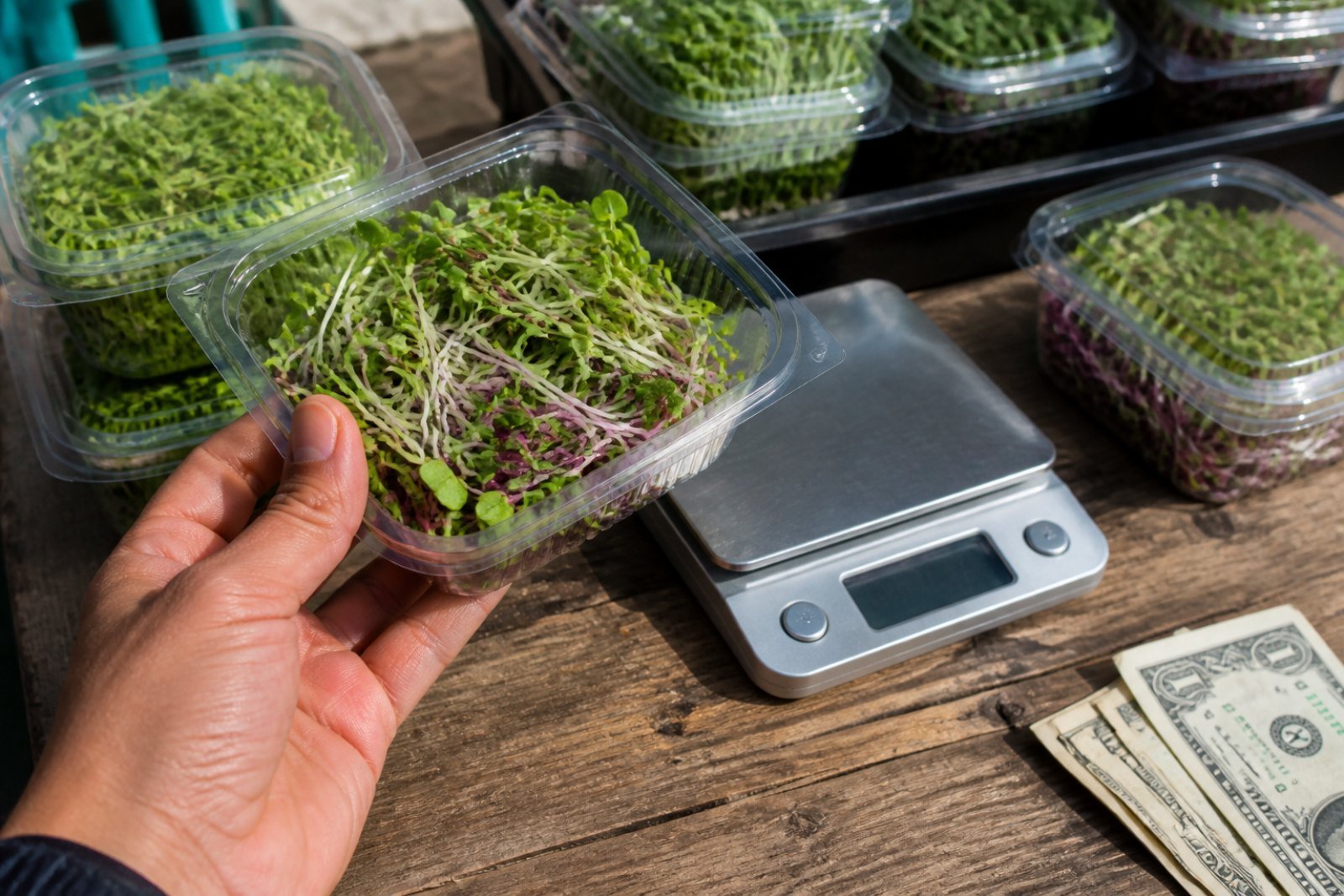
Compare by weight, not by box. We found no national price survey for market microgreens, so the honest tool is simple math: divide the price by the ounces on the label.
Penn State gives one real example. It has seen microgreens sold at $1.75 for half an ounce through a direct market, and at $40 a pound wholesale (Sánchez & Berghage, 2025). That’s $3.50 an ounce direct and $2.50 an ounce wholesale. Prices in your town may run higher or lower, so use per-ounce math to compare the stalls in front of you.
Then weigh the price against the cut date. A cheaper pack cut four days ago has fewer good days left than a pricier one cut yesterday.
Cost does hold people back. In a Colorado taste panel, buyers named cost, access and freshness among the reasons they might not buy microgreens, even after rating them well (Michell et al., 2020). When buying microgreens at a farmers market, per-ounce math and a cut date turn price into a fair comparison.
How do you get farmers market microgreens home fresh?
Keep them cold and keep them apart from raw meat. The FDA says to bag fresh produce separately from raw meat, poultry and seafood on the way home (U.S. Food and Drug Administration, 2024).
Make the microgreens one of your last stops, or bring a cooler bag with an ice pack. Room temperature is hard on cut greens, as the booth section showed, and a hot car is worse.
At home, the FDA says to store perishable produce in a clean fridge at 4°C (40°F) or below (U.S. Food and Drug Administration, 2024). Put the pack on a shelf as soon as you’re in the door, before you unpack anything else.
Hold off on rinsing. New Mexico State University says to wash microgreens when you prepare your meal, not anytime before, since early washing damages the tissue and adds moisture (New Mexico State University, n.d.-a).
That covers the trip home after buying microgreens at a farmers market. Our storage guide picks up from the fridge shelf, with the research on containers and temperature.
Wrap-up: buying microgreens at a farmers market
Ask when the greens were cut, and count from that day. Buy from a display that’s cold, with dry packs and the lid on. Then get them into your fridge without a long, warm detour. That’s one question and two quick looks, and it takes less than a minute at the stall.
A good market makes all of that easy, and the hard part is often finding one. The farmers market finder on our sister site, Microgreens World, searches by state, county or zip code. To find growers by location, try the Microgreens 411 directory. Coverage varies by region, so some areas have few listings so far.
Microgreens 411
Find a microgreens grower near you
Greens that travel less start fresher in your fridge. Find my local grower →
Frequently asked questions
Are farmers market microgreens safe to eat raw?
Microgreens are about as risky as any fresh produce eaten raw, according to New Mexico State University. If raw tomatoes and lettuce are already part of your meals, microgreens don’t call for extra worry. They call for the same care (New Mexico State University, n.d.-b).
Are microgreens the same as sprouts?
No. Microgreens grow in a medium under light, and only the top is cut and eaten. Sprouts are eaten whole (New Mexico State University, n.d.-b). The FDA advises people at higher risk of foodborne illness to avoid raw or lightly cooked sprouts (U.S. Food and Drug Administration, 2024). Our sprouts guide covers the rest.
Do farmers market microgreens have to be certified organic?
Not always. Growers who sell $5,000 or less in organic products a year are exempt from certification, but they still have to follow the organic production rules (U.S. Department of Agriculture, Agricultural Marketing Service, n.d.). If organic matters to you, ask whether the grower is certified or exempt.
Why do microgreens cost more than you might expect?
Penn State calls microgreens very labor-intensive. Most of the work comes at planting and harvest, and harvest takes the most time of any step (Sánchez & Berghage, 2025). Small batches cut by hand carry that work in the price.
Can you buy microgreens that are still growing?
Yes, from some growers. Penn State describes selling microgreens in seeding trays, or on mats inside vented clamshells, so they reach the buyer uncut (Sánchez & Berghage, 2025). New Mexico State University advises against cutting microgreens until you’re ready to eat them (New Mexico State University, n.d.-a).
Do microgreens have more nutrients than full-grown vegetables?
Penn State notes research showing microgreens tend to have higher vitamin concentrations than the same plants grown to maturity (Sánchez & Berghage, 2025). That’s a general finding, not a promise for every crop or every nutrient. Our nutrition guide goes crop by crop.
References
Chen, H., Tong, X., Tan, L., & Kong, L. (2020). Consumers’ acceptability and perceptions toward the consumption of hydroponically and soil grown broccoli microgreens. Journal of Agriculture and Food Research, 2, 100051. https://doi.org/10.1016/j.jafr.2020.100051
Kelley, K. (2025, June 4). Marketing microgreens. Penn State Extension. https://extension.psu.edu/marketing-microgreens
Michell, K. A., Isweiri, H., Newman, S. E., Bunning, M., Bellows, L. L., Dinges, M. M., Grabos, L. E., Rao, S., Foster, M. T., Heuberger, A. L., Prenni, J. E., Thompson, H. J., Uchanski, M. E., Weir, T. L., & Johnson, S. A. (2020). Microgreens: Consumer sensory perception and acceptance of an emerging functional food crop. Journal of Food Science, 85(4), 926–935. https://doi.org/10.1111/1750-3841.15075
New Mexico State University. (n.d.-a). Eating microgreens. All About Microgreens. https://all-about-microgreens-d.nmsu.edu/consumers.html
New Mexico State University. (n.d.-b). All about eating and growing microgreens. All About Microgreens. https://all-about-microgreens-d.nmsu.edu/
Sánchez, E., & Berghage, R. (2025, December 16). Growing microgreens. Penn State Extension. https://extension.psu.edu/growing-microgreens
U.S. Department of Agriculture, Agricultural Marketing Service. (n.d.). Strengthening organic enforcement frequently asked questions. https://www.ams.usda.gov/rules-regulations/strengthening-organic-enforcement/faq
U.S. Food and Drug Administration. (2024, March 5). Selecting and serving produce safely. https://www.fda.gov/food/buy-store-serve-safe-food/selecting-and-serving-produce-safely
Yeargin, T. A., Lin, Z., do Prado, I., Sirsat, S. A., & Gibson, K. E. (2023). Consumer practices and perceptions regarding the purchasing and handling of microgreens in the United States. Food Control, 145, 109470. https://doi.org/10.1016/j.foodcont.2022.109470