

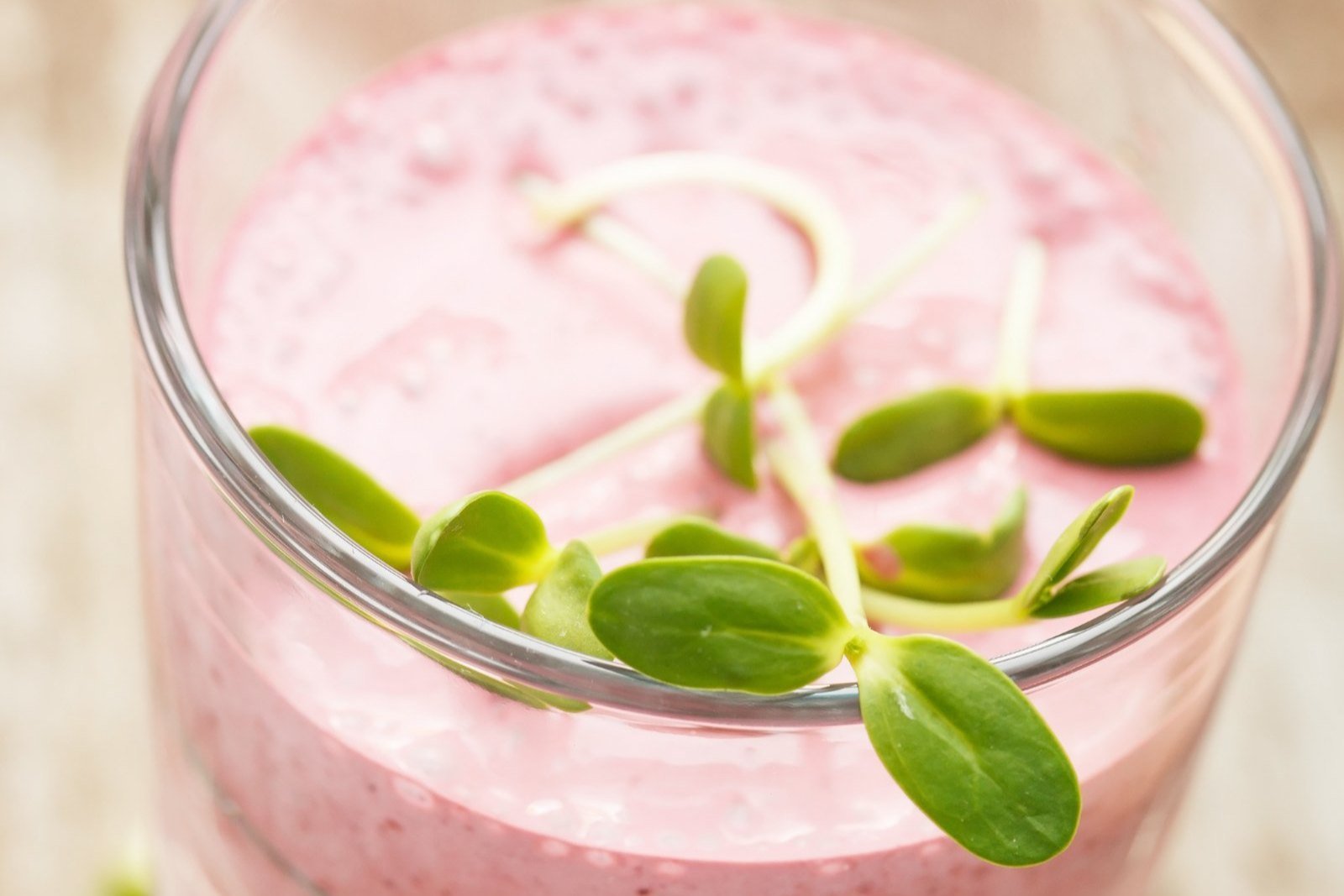
Yes, you can.
Microgreens blend into a smoothie much like spinach or kale. Several university extension services suggest it as an easy way to eat more vegetables. The catch is flavor. A mild kind fades into the fruit. A peppery kind can take over the whole glass. This guide covers which kinds suit a microgreens smoothie, how much to add, what blending does to the plant compounds and how to keep the drink safe. Every claim has a source behind it, so you can test the idea in your own kitchen.
Key Takeaway
Yes. Clemson Extension says you can add microgreens to smoothies for an extra serving of vegetables (Dabbs, 2020). Pick a mild kind such as sunflower, start with a small handful and wash the greens first. Refrigerate any leftover smoothie within 2 hours.
Below: whether microgreens work in a smoothie, which kinds taste best, how much to add, what blending changes, how to keep it safe and how to plan ahead.
Microgreens 411
Find a microgreens grower near you
Greens that travel less start fresher in your fridge. Find my local grower →
Table of Contents
- Can you put microgreens in a smoothie?
- Which microgreens taste best in a smoothie?
- How many microgreens should you add to a smoothie?
- Does blending change the nutrients in microgreens?
- Are raw microgreens safe in a smoothie?
- Can you make a microgreens smoothie ahead of time?
- Wrap-up: making a microgreens smoothie
- Frequently asked questions
- References
Can you put microgreens in a smoothie?
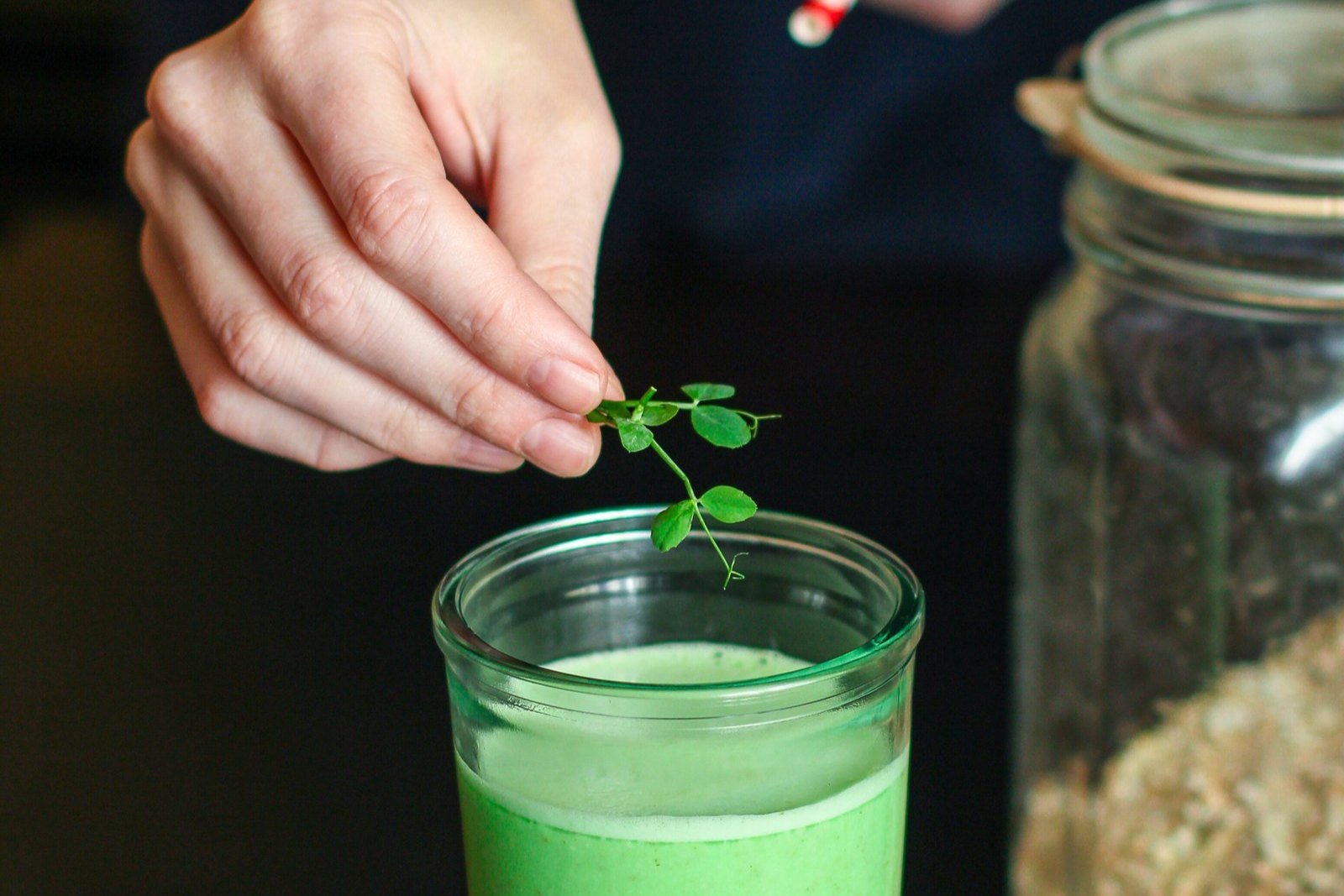
Yes, and extension educators recommend it. Clemson Extension says, “You can even add microgreens to smoothies for an extra serving of vegetables!” (Dabbs, 2020). A talk posted by University of Arizona Extension lists tossing a small handful into a smoothie or juice before blending as one easy way to use them (Mountain View Garden Club, 2019).
A Colorado State Extension volunteer writes that sprouts and microgreens, fresh or frozen, make a wonderful addition to smoothies (Davis, 2024). So the microgreens smoothie is a common idea, not a stunt.
It works for a plain reason. Microgreens are tender stems and leaves, so a blender breaks them down fast. Penn State notes that people normally eat microgreens raw (Di Gioia, 2024), and a smoothie keeps them raw.
There is one trade-off. A smoothie hides the crunch and color that make microgreens worth their price on a plate. If texture is the point, put them on food instead. Our guide to everyday uses has ideas for that.
The table sums up the basics.
| Question | Short answer |
|---|---|
| Best kinds to start with | Mild ones, such as sunflower |
| How much to add | A small handful, then adjust |
| Before blending | Rinse under running water |
| Leftovers | Into the fridge within 2 hours |
Which microgreens taste best in a smoothie?
Mild ones, at least at first. Clemson Extension notes that microgreens are grouped by flavor, such as spicy or mild (Dabbs, 2020). That grouping matters more in a drink than on a plate, since you taste every sip.
Peppery kinds are the risky picks. Oregon State Extension says mustard and radish microgreens give “a spicy kick” (Pokorny, 2024). Penn State links the pungent taste of cabbage-family crops to natural compounds called glucosinolates (Di Gioia, 2024). The Colorado State writer who likes microgreens in smoothies says she does not find radish appealing in one (Davis, 2024).
Sunflower is a safer bet. Oregon State describes sunflower microgreens as nutty (Pokorny, 2024), and a Nebraska recipe builds a whole microgreens smoothie around them (Dalal, n.d.). If you are curious about broccoli, our broccoli microgreens guide describes its taste.
Mixed packs need a second look. A blend may include radish or mustard, so read the label before a mix goes in the blender. Tasting one leaf on its own tells you more than the label can. Our flavor guide sorts the common kinds from mild to hot.
How many microgreens should you add to a smoothie?
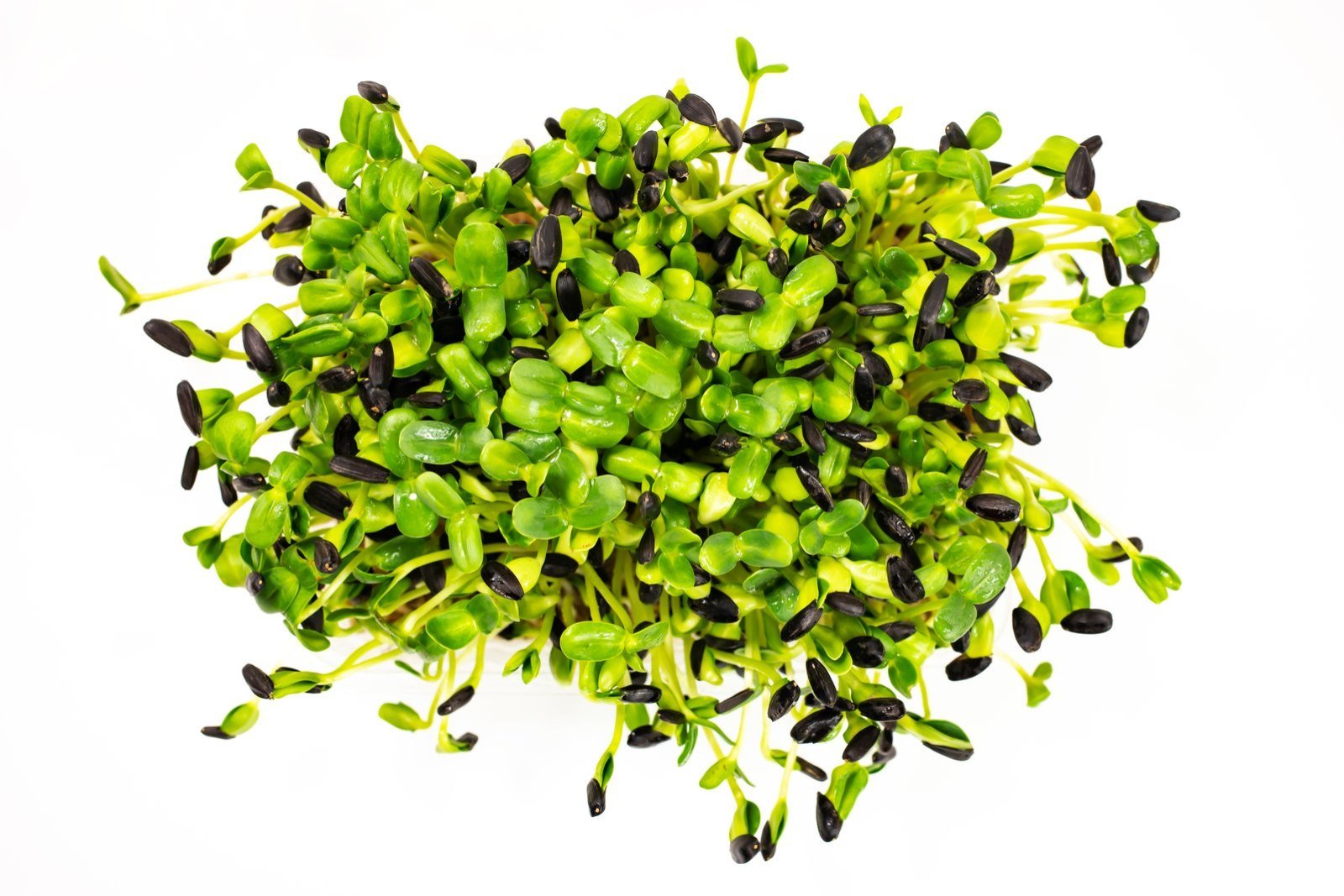
Start small, then adjust to taste. The University of Arizona Extension talk suggests a small handful (Mountain View Garden Club, 2019). The Nebraska sunflower recipe uses 1/2 cup of microgreens with one banana and one apple, plus cold water (Dalal, n.d.).
No source sets an ideal amount for a microgreens smoothie. Recipes differ, and flavor strength differs between crops. A sensible plan is to begin with a small handful of a mild kind. If you like the taste, add more the next time.
For scale, one research team gave each adult a serving of 16 grams (0.56 ounce) of fresh broccoli microgreens (Bouranis et al., 2023). The volunteers ate them with breakfast, not in a smoothie. Even so, it shows what researchers treated as one serving.
The Nebraska recipe lists lemon juice, hemp seeds and a handful of spinach as optional extras (Dalal, n.d.). Treat any recipe as a starting point and change one thing at a time. Our recipes page has more pairings for different kinds.
Does blending change the nutrients in microgreens?
It changes some plant compounds, and that is part of the appeal. The Linus Pauling Institute at Oregon State explains that cabbage-family vegetables hold compounds called glucosinolates. In an intact plant, an enzyme called myrosinase is kept apart from them. When plant cells are damaged, the two meet and form new compounds, such as isothiocyanates (Higdon et al., 2016).
Chopping or chewing raw crops sets off that reaction, and boiling turns the enzyme off (Higdon et al., 2016). A blender breaks cells without heat, so a raw smoothie should leave the enzyme working. We found no study that measured these compounds in a microgreens smoothie, so treat this as the chemistry, not a test result.
Broccoli microgreens are a rich source of the starting compound for sulforaphane. In an Oregon State study, they held about as much as broccoli sprouts, and 11 healthy adults absorbed sulforaphane after one serving (Bouranis et al., 2023). That study measured absorption, not health effects, and no trial tested smoothies.
This article is general information, not medical advice. Ask your doctor or pharmacist about your own situation.
Are raw microgreens safe in a smoothie?
Yes, if you handle them like other raw produce. New Mexico State University says microgreens should be washed before eating, just like any fresh produce. It adds that you should wash them right before you eat them, not any sooner (New Mexico State University, n.d.).
The FDA advises washing produce under running water and says soap, detergent or commercial produce wash is not recommended. It says to keep produce you will eat raw away from raw meat, poultry and seafood (U.S. Food and Drug Administration, 2024). Our washing guide walks through the steps.
Once blended, your microgreens smoothie is a perishable food. FoodSafety.gov says to refrigerate perishable food within 2 hours, or within 1 hour above 32°C (90°F). It sets the fridge at 4°C (40°F) or below (FoodSafety.gov, 2023). A glass left on the counter all morning would miss that window.
Start with fresh greens too. NMSU says to eat microgreens no later than 3 to 5 days after harvest (New Mexico State University, n.d.). Our food safety guide covers illness risk and who should take extra care.
Can you make a microgreens smoothie ahead of time?
Yes, for a short time. The Nebraska recipe says to refrigerate leftovers for up to 24 hours (Dalal, n.d.). That fits the FoodSafety.gov rule, as long as the glass goes back in the fridge soon after blending (FoodSafety.gov, 2023). Put the time on the jar so you know when the day is up.
The greens are harder to plan around than the drink. NMSU says cut microgreens go bad very quickly at room temperature and should be kept dry (New Mexico State University, n.d.). Buy a pack you will finish within a few days. Our storage guide explains how to keep it fresh.
Some cooks freeze extra microgreens for later smoothies. The Colorado State Extension volunteer puts tired greens in a zip bag in the freezer and uses them in smoothies or stir fries (Davis, 2024). That is one cook’s habit, not a tested method. Our freezing guide looks at what changes.
Fresher greens give you more days to use them. Buying from a nearby grower can shorten the trip from harvest to blender. The Microgreens 411 directory lists growers by town.
Wrap-up: making a microgreens smoothie
Microgreens blend well, and extension educators suggest them for smoothies. Start with a small handful of a mild kind such as sunflower. Save radish and mustard for days you want heat. A raw smoothie keeps the plant enzyme working, but no trial has tested health effects from drinking one.
Wash the greens right before blending, and get leftovers into the fridge within 2 hours.
Want fresher greens for your blender? Search your town in the Microgreens 411 directory to find growers near you. Coverage varies by region, so some areas have few listings so far.
Microgreens 411
Find a microgreens grower near you
Greens that travel less start fresher in your fridge. Find my local grower →
Frequently asked questions
Which microgreen has the most vitamin C?
In a lab study of 25 commercial microgreens, red cabbage had the most vitamin C. Levels across all 25 ranged from 20.4 to 147.0 mg per 100 grams of fresh weight (Xiao et al., 2012). The study measured the greens, not effects in people.
Can you use sprouts instead of microgreens?
You can, but sprouts carry their own risk. The FDA says sprouts grow in warm, humid conditions that favor bacteria. It advises children, older adults, pregnant women and people with weakened immune systems to avoid raw or lightly cooked sprouts of any kind (U.S. Food and Drug Administration, 2024).
Why do some microgreens taste bitter?
Cabbage-family crops contain sulfur compounds that give a pungent smell and a spicy flavor, which some people describe as bitter (Higdon et al., 2016). A milder crop, such as sunflower, is an easier start for a picky drinker.
Has a broccoli drink been tested in people?
Yes, with sprouts. In a trial with 50 adults in Qidong, China, about 70% of the sulforaphane from a sulforaphane-rich sprout drink showed up in urine, a measure of absorption. For a drink holding only its starting compound, the figure was about 5% (Egner et al., 2011).
What can you do with microgreens too spicy to blend?
Cook them into other food. A Colorado State Extension writer adds sprouts and greens to salads, salsa, stir fry and scrambled eggs. She once chopped some into enchilada filling, and no one noticed them (Davis, 2024).
Are microgreens the same as baby greens?
No. A University of Arizona Extension talk puts microgreens at 2 to 3 inches tall, cut 7 to 21 days after planting. Baby greens are 4 to 6 inches tall and take 21 to 40 days (Mountain View Garden Club, 2019).
References
Bouranis, J. A., Wong, C. P., Beaver, L. M., Uesugi, S. L., Papenhausen, E. M., Choi, J., Davis, E. W., II, Da Silva, A. N., Kalengamaliro, N., Chaudhary, R., Kharofa, J., Takiar, V., Herzog, T. J., Barrett, W., & Ho, E. (2023). Sulforaphane bioavailability in healthy subjects fed a single serving of fresh broccoli microgreens. Foods, 12(20), 3784. https://doi.org/10.3390/foods12203784
Dabbs, A. (2020, July 8). Growing microgreens at home or in the classroom. Clemson Cooperative Extension, Home & Garden Information Center. https://hgic.clemson.edu/growing-microgreens-at-home-or-in-the-classroom/
Dalal, A. (n.d.). Sunflower microgreen smoothie. Buy Fresh Buy Local Nebraska. https://buylocalnebraska.org/sunflower-microgreen-smoothie/
Davis, M. (2024). Growing sprouts and microgreens at home. Colorado State University Extension, Pueblo County. https://pueblo.extension.colostate.edu/growing-sprouts-and-microgreens-at-home/
Di Gioia, F. (2024, March 28). The ABCs of microgreens. Penn State Extension. https://extension.psu.edu/the-abcs-of-microgreens
Egner, P. A., Chen, J. G., Wang, J. B., Wu, Y., Sun, Y., Lu, J. H., Zhu, J., Zhang, Y. H., Chen, Y. S., Friesen, M. D., Jacobson, L. P., Muñoz, A., Ng, D., Qian, G. S., Zhu, Y. R., Chen, T. Y., Botting, N. P., Zhang, Q., Fahey, J. W., … Kensler, T. W. (2011). Bioavailability of sulforaphane from two broccoli sprout beverages: Results of a short-term, cross-over clinical trial in Qidong, China. Cancer Prevention Research, 4(3), 384–395. https://doi.org/10.1158/1940-6207.CAPR-10-0296
FoodSafety.gov. (2023, September 18). 4 steps to food safety. U.S. Department of Health and Human Services. https://www.foodsafety.gov/keep-food-safe/4-steps-to-food-safety
Higdon, J., Drake, V. J., & Delage, B. (2016). Cruciferous vegetables. Micronutrient Information Center, Linus Pauling Institute, Oregon State University. https://lpi.oregonstate.edu/mic/food-beverages/cruciferous-vegetables
Mountain View Garden Club. (2019, March 8). Microgreens [Presentation slides]. University of Arizona Cooperative Extension. https://extension.arizona.edu/sites/extension.arizona.edu/files/attachment/Microgreens.pdf
New Mexico State University. (n.d.). Eating microgreens. All About Microgreens. https://all-about-microgreens-d.nmsu.edu/consumers.html
Pokorny, K. (2024, February). Microgreens add big flavor from a small footprint. Oregon State University Extension Service. https://extension.oregonstate.edu/news/microgreens-add-big-flavor-small-footprint
U.S. Food and Drug Administration. (2024, March 5). Selecting and serving produce safely. https://www.fda.gov/food/buy-store-serve-safe-food/selecting-and-serving-produce-safely
Xiao, Z., Lester, G. E., Luo, Y., & Wang, Q. (2012). Assessment of vitamin and carotenoid concentrations of emerging food products: Edible microgreens. Journal of Agricultural and Food Chemistry, 60(31), 7644–7651. https://doi.org/10.1021/jf300459b